Wed 8 Jun 2022
Angela Davis on “the possibility of unity on different grounds”
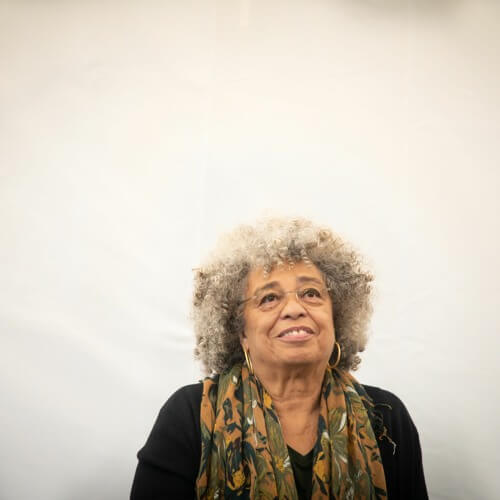
How to avoid destructive polarisation? How to work with other groups that sometimes have diverging views? How can social movements, activists and civil society organisations better collaborate at global level? These questions, among others, were answered by Angela Davis in the course of a rainy afternoon, where we had the chance of interviewing her during a short pit-stop in Belgium.
“Tireless revolutionary”, civil rights activist, feminist, intellectual and author, Angela Davis is known for her fight against injustice and inequality and for her unwavering commitment to all her struggles, which landed her in the 1970s on the FBI’s Most Wanted list.
"We often assume that unity happens by leaving differences aside, by transcending differences, or by uniting across differences, but I am wondering, and I am not the only one of course, whether we might not need to utilise a different notion of what it means to unite," she questioned. "Our differences could be the glue that holds us together. It contests the idea that we all have to be the same to unite in a racist society that often incorporates white supremacy principles of sameness”.
“Freed by the people”
No single person sits more squarely at the intersection of transnational struggles for justice than Angela Davis. Her arrest, incarceration, and trial formed a triad considered among the “most widely debated legal cases in world history”. “Public enemy number one to some, a beacon of hope to others”. While President Nixon labeled Davis a “dangerous terrorist”, people around the globe rose up to protest in her name that formed the basis of a remarkable defense campaign. "Free Angela Davis” - the emblematic slogan echoing from Delhi to New York infused with Black liberation, anticapitalism and feminism.
Decades later, Davis, now 78 years old, continues to influence.
From the crisis in Ukraine, and the need for peace movements, to “cancel culture”, the rise of the ultra-right and the persistence of structural racism, Davis advocates for reinforced forms of collaborations on all topics as the key to imagine “the future that we need.”
“Oftentimes when we assume that we made progress, we haven’t been making progress at all. I want to urge a critical stance to always question, not only what our goal should be, but the conceptual apparatus that we use to articulate our goals.”
As civic space continues to shrink for activists and civil society organisations, branching out has become a necessity. As described in the Future Convergence Forus Barefoot guide, written by thirty-one civil society leaders and practitioners from twenty countries from across the world, “we have to find new ways in which to respond together, requiring unprecedented levels of trust, care and collaboration on a scale never seen before in our history.”
How can we step out of our silos and corners and turn towards each other to mobilise and multiply our collective potential? Maybe by transforming our definition of “unity”, focusing on the intersections of struggles and building “profound community and connections with other people.”
“That is the perennial question isn’t it? How to unite, how to collaborate, how to come toghether. I would suggest that we think about how we have conceptualised the process of unity, of unity in struggle,” Davis commented. “What about uniting with our differences? What about the possibility that differences can actually bring us together? Rather than disunite us. It seems to me that that is going to be the challenge”.
For people engaged in political work, Davis advised that “it's not about individual characteristics, it’s about the willingness of always being a part of collectives.” She attributes this to the reason why she has been able to be part of social justice movements for so long. “It’s never only about me, it’s always about those with whom I make community, and those with whom I struggle”.
/ Podcasts
EN - Interaction with activist Angela Davis
“Collaboration is the very core of activism”
“Young people are always at the forefront of radical change,” Davis expressed, talking about her activism journey which started at an early age. Born in Birmingham, Alabama, Davis’ chilhood neighborhood was nicknamed “Dynamite Hill” because the Ku Klux Klan often attacked the homes of Black residents with bombs. For Davis, today’s challenges are interconnected.
“People who are focused largerly on struggles against racism and colonialism also have to take up the battle against environmental pollution,” Davis explained.
"I think that the spending on space expeditions by billionaires, like Elon Musk or Jeff Bezos, is a sign that the ultra-wealthy are now considering the possibility of colonizing other planets in order not to be concerned about the future on this planet,”Davis said, highlighting the belief that “environmental justice is the pre-condition for all other forms of social justice”.
But what’s most important according to Davis, “is not so much the identity of particular individuals who are involved in the struggles but the capacity to think these issues toghether.” “Collaboration is the very core of activism, although many people see activistm as a way to acquire a name for themselves,” she added.
Finally, for radical change to emerge, we need to follow the leadership of those who have been most marginalised and those “whose struggle represent a dream of freedom for everyone”.
© Cover picture Ioanna Gimnopoulou/ Angela Davis picture Forus/Both Nomads.