

Tue 7 Mar 2023
Aruna Roy: “The structures of power have to be questioned and made to deliver”
As part of the March With Us campaign, a full month of stories from women at the forefront of social change, we sat down with renowned activist Aruna Roy, to discuss gender justice in India and beyond.
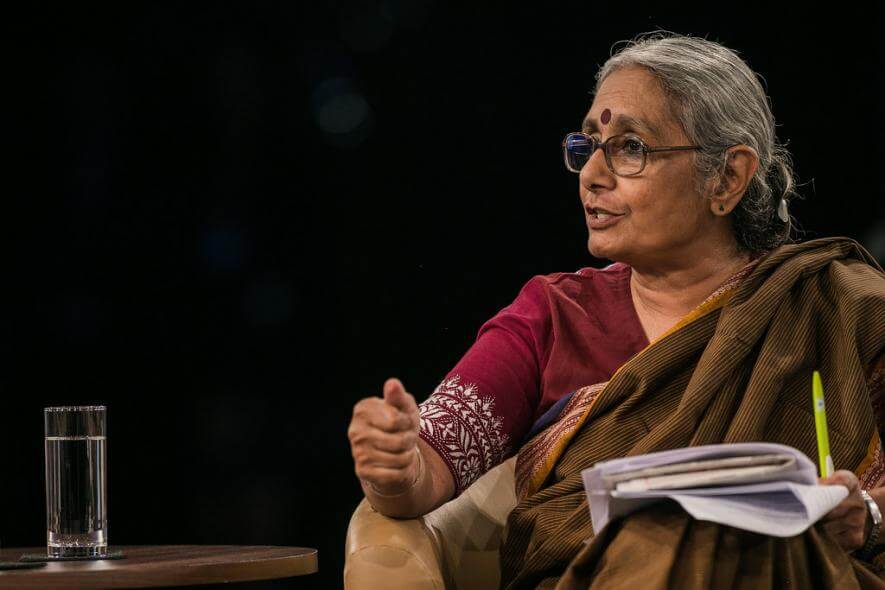
Aruna Roy
Aruna Roy is an Indian social activist, professor, union organiser and former civil servant. She is the president of the National Federation of Indian Women and founder of the Mazdoor Kisan Shakti Sangathan.
What does being an activist mean to you ?
Activists are compelled to respond to address injustice and speak with the powerless, vulnerable, and those without privilege. An activist works to make power transparent, accountable and just.
You are founder of the Mazdoor Kisan Shakti Sangathan (MKSS) organisation. Can you tell us more about your mission and objectives?
The MKSS believes that all struggles for equality are rooted in a political understanding of democracy for realizing constitutional rights independence, promised to cherish the dreams of freedom from hunger, injustice and to promote access to basic rights. However, these rights seem inaccessible and every demand for it, remains a struggle with vested interest. Representative politics has fallen prey to corruption and the arbitrary use of power. Democratic institutions have been co-opted by the power elite and the hiatus between the rich and the poor has increased.
The MKSS works with the community to use democratic tools of non-violent protest to understand that governance structures must be transparent and held accountable. One of the tools that emerged was the concept of public / social audit. The process involves talking truth to power, in a public meeting and making power accountable, in the demand for answers.
Working with the community is a continuing dialogue. The structures of power have to be questioned and made to deliver.
Freedom of expression is often interpreted as dissent, even though it is the spirit of democracy.
We understand you are a former civil servant and we want to know how your country’s government has been reacting towards your initiatives in the fight for justice. Is there a difference between the past and present as far as their reactions are concerned? What are the main challenges facing women in India today?
Those of us born on the cusp of independence in India, saw a free country emerging from communal conflict, and choosing to be a secular Republic, to face the difficult task of governing a large plural population- with multi faith, 22 official languages and cultures.
In the last decade we have witnessed people lose access to public spaces and the right to differ, dissent and disagree. In other words, the spaces for protest, both physical and in ideas is disappearing. The net is closing in on freedom of political thought. It was announced recently that extremists are not merely those who use weapons of destruction, but also those using their minds and pens.
Large protests for constitutional rights, equality and liberty, like those against the The Citizenship (Amendment) Act (CAA) - for equal citizenship and the Farmer’s rights, were constantly under threat of the government taking punitive action against protesters. Posts by young people on social media and even acts of charity have led to arrests, with charges of anti-nationalism and working against the state. The people claim constitutional guarantees, as elected governments act against inviolable rights, using arbitrary power.
The space to protest is therefore sacred and contested in democracies. Access to places of public protest have been officially restricted. Freedom of expression is often interpreted as dissent, even though it is the spirit of democracy, the right to be heard its translation into practice.
Increasingly, despite the presence of millions of voters, the pool of decision makers gets smaller and narrower at the top. Decisions that affect millions of people are taken by a few without consultation. The Mazdoor Kisan Shakti Sangathan (MKSS) believes that public space and the street are our Parliament and our policy room.
When public space was closed to protestors, the MKSS filed a Public Interest Litigation (PIL) in the Supreme Court of India, to regain access to the Jantar Mantar, a street; a space in the middle of Delhi dedicated to protests. A favorable judgement helped regain access to it in July 2018.
Women too, unfortunately are not free from religious and caste identity formations. But we do unite on violence against our bodies. India has seen mass protests against rape, assault and social customs like dowry - induced deaths.
Poor women face threats to their livelihood. The women who work as laborers and access work from the State-run entitlements like the Mahatma Gandhi National Rural Employment Guarantee Act 2005 (MGNREGA), enable every rural family, with a guarantee of 100 days employment in a year, with penalties on government for non-compliance. We believed that the discourse had established the effectiveness and validity of entitlements like the MGNREGA, to eradicate poverty and enable workers to live with dignity and social justice. However, the government of India, is now restricting this right through financial stringency and technological controls- quoting efficiency.
Since the 1970s you have worked in the rural areas of Rajasthan. What can we learn from the civic engagement of people and communities in areas that are historically marginalized?
Rajasthan’s socio-economic-political history of being ruled by monarchies and colonial governments, saw a huge change with the promise of independence, democracy and the right to vote. The expectations of people grew. They believed that their basic needs would be met, as they now had rights defined in, and by the Indian Constitution.
When the hostile environment of work and employment, access to schooling, health and livelihood remained the same, fundamental questions began to be asked. Most of the men in the community and many women migrated for work. Distress migration was the norm. Our work began with the demand for work and fair wages.
In simple terms, the MKSS worked for equality and rights within the framework of constitutional values and principles. Equality became a lived principle. The Devdungri home, in the Rajsamand District of Rajasthan, where the MKSS lived and worked is a stone and mud construction, and small. We lived and ate like the people we worked with. MKSS activists drew the same wage as an agricultural worker, as prescribed by the law. The organization was crowdfunded. These important lifestyle decisions prevented the usual suspicions about funding and ‘the foreign hand’, used very often to quell protest and demands for rights, by the government and local administration. The organizational structure was participatory, democratic and equal. There was and is, no one leader - all decisions were taken collectively. The definition of a struggle, its limitations and objective were designed with people, and drew strength from their common sense and judgement and their staying power. The struggle did not depend on remunerations of any kind. We need to reiterate that it begins with listening to people, as equals.
Activists listen to people as equals. These dialogues often lead to collectives working together to bring in structural changes. The Right to Information law (RTI) and the right to work law- (MGNREGA) were fashioned with people and their campaigns. They were both pan-Indian movements and campaigns. The MKSS work defined the RTI, and rekindled the demand for the MGNREGA with others in India. Policy and legal formulations should be participatory in a democracy.

EN - Aruna Roy on gender justice and the Right To Information movement
In 2005, the MKSS played a pivotal role in drafting and advocating for the Right to Information Law which was passed by the Indian Parliament. This must have been a great milestone for all those involved. Can you tell us about it, and what can other activists can learn from this?
The demand for wages, led logically to the importance of records, and systematically to the way people were governed. Corruption and arbitrary use of power, led to protests and the formation of the National Campaign for People’s Right to Information, (NCPRI) in 1996, and the engagement with the Press Council of India and its chair, Justice Sawant, who agreed to preside over the drafting of the law.
It all began with MKSS’s specific demand for copies of financial records of expenditure incurred in the local government institutions including Panchayats. In 1993/4, in the absence of a law, the MKSS had to mostly rely on informal means and sympathetic officials for access to these documents. Public hearings were organized where residents came together to verify and audit the work of their Panchayat through individual and collective testimonies. Huge amounts of fraud and lies were exposed.
The trajectory from village panchayat to parliament became visible through the protest. People came to understand the importance of an entitlement. After a prolonged sit in of 53 days, in July 1997, the Government of Rajasthan amended the Panchayati Raj Rules, for people to access financial records of the village council. Many state laws were passed including the Rajasthan State Right to Information Act. However, the State Acts were varied in their formulations.
Many State laws were passed. Despite bureaucratic subterfuge, and resistance from various quarters, vigilance and advocacy by citizens groups helped ensure that a strong right to information was passed by the Indian Parliament in June 2005, which came into effect on the 12th of October 2005.
Your book on the campaign “The RTI (Right to information) story: power to the people”? tells the story of how ordinary people can come together and prevailed against great odds. What is the story and motivation behind writing this book?
The book is a story that traces the contribution of people and the history of the RTI campaign. The inspiration is people, always people- not an abstraction, but individuals, their intelligence and political acumen, their ideas and ultimately their determination and courage. They are the source of strength to face what may often seem like impossible situations.
The book was put together to acknowledge the immense contribution of people often dismissed by history and marginalized from the process of governance. It was also a statement of the fact that policy making and drawing up legal instruments, can be participatory; a democratic process. Specialization brings in skills, to transform ideas into legal tools, but everyone can think. People who seek remedies and suffer from injustice, often know best about what will work.
What would you say has been the most unforgettable thing or lesson (or a remarkable moment you want to share) about your journey so far?
There is no one instance or a lesson that guides us through life. It is a walk, a march if you like, with principles of equality and a continuing search for truth, justice and compassion. It is a willingness to learn from every experience, to laugh, sing and struggle together. It is a journey with a strong determination to speak truth to power.
Although great strides have been made to hold the government accountable and also to force them to pass laws which favor people’s freedom and guarantee their social rights, India still has a long way to go to achieve more balance and ensure a fair treatment for all.