© NGO Forum on ABD
© Forus
2025-09-01
Beyond FfD4: Civil Society Lead in Reform of Global Financial Architecture
As a global civil society network, our priorities in Financing for Sustainable Development align with the urgency to challenge power imbalances in global financial governance and ensure that development finance truly benefits communities with a focus on localization, an enabling environment for civil society, and climate and gender justice.
Over the past months, Forus’ delegation of around twenty national and regional civil society platforms engaged in the Fourth International Conference on Finance for Development (FfD4) to not only raise concerns but also contribute to solutions on how to address the financing gap to achieve the SDGs, now estimated to be as high USD 4 trillion annually. What came out of this experience shows both the big challenges we face and the real opportunities ahead, making it clear why the next steps in global finance will be so important for pushing the change we need.
The financing agenda has been especially challenging today as we see government commitments to official development assistance (ODA) slashed. In a recent report by the Development Assistance Committee (DAC) of the Organisation for Economic Co-operation and Development (OECD) on projected cuts to ODA in 2025, the OECD forecasts a further decline of 9-17%, on top of a 9% drop in 2024 – a troubling trend for development financing amid rising global needs.
The projected decline is driven by announced cuts in four major providers of ODA – France, the UK, Germany, and the US. The needs continue to grow, and the projected ODA cuts will impact the poorest countries and vital services hardest.
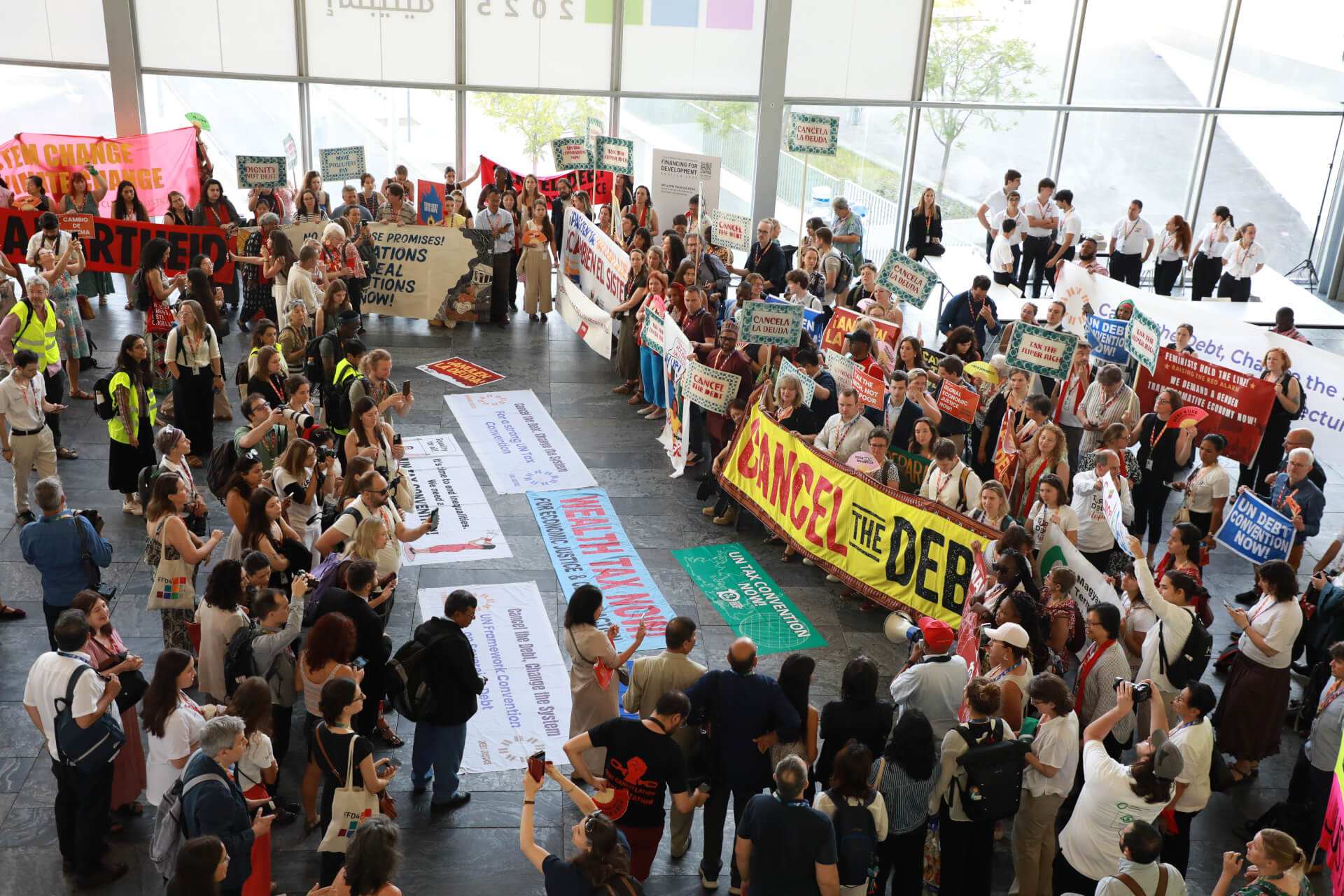
At the same time, global priorities continue to lean towards increased military spending and fossil fuel subsidies – rather than equitable and sustainable development. FfD4, including civil society events such as the Feminist Forum, Civil Society Forum, and mobilization activities, provided opportunities for hundreds of civil society organizations (CSOs) worldwide to unite around a shared call: it’s time to transform how global development is financed. The “how” must finally address gender justice by enabling a gender-just economy, in which financing for development (FfD) will result in equitable outcomes and fair distribution of resources capable of promoting social, economic, and environmental justice and strengthening democracy and multilateralism, as highlighted in the FFD4 Feminist Forum Declaration.
From ODA cuts to the lack of debt relief and the shrinking civic space, FfD4 was an opportunity for civil society to build solidarity and push back against top-down, donor-led models. CSOs came together to call for a UN-led framework for democratic development cooperation, just and transparent debt workout mechanisms, ODA that strengthens public services and human rights, and an enabling environment for civil society.
An FfD4 side event and discussion space titled, ‘Strengthening Relations Between Public Development Banks and Civil Society to Promote People-centered and Locally Led Development,’ responded to these demands. The panel brought together representatives from Finance in Common, two national development banks (Nigeria and France), and three multilateral development banks (MDBs) – the World Bank, the Asian Development Bank (ADB), and the European Bank for Reconstruction and Development (EBRD) – via video, offering a strategic space for dialogue on aligning public finance with the priorities of local communities and civil society.
The event launched a new documentary titled, ‘Financing Change.’ In the context of major ODA cuts, governments are increasingly looking towards the role of MDBs and the private sector to plug the gap in development finance. With public development banks (PDBs) managing over USD 23 trillion in assets, the stakes cannot be higher.
The key message of the event was that development and climate goals will not be met unless PDBs fundamentally shift how they operate, putting people and communities at the center. Participants called for: development that is locally led and anchored in the lived realities of communities; finance that is transparent, accountable, and serving people and the planet; and institutionalized dialogue between CSOs and PDBs.
These priorities are detailed in our recent study reviewing civil society engagement mechanisms across seven MDBs. The findings and recommendations highlight that finance must be people-centered, locally led, and accountable. A new model is urgently needed, one that shifts power, not just capital.
This call for transformation was further reinforced in another FfD4 side event titled, ‘Beyond GDP: Rethinking Finance for Sustainable Development.’ The event, which featured the participation from the Government of Spain (FfD4 country host) and the Government of Colombia, highlighted how gross domestic product (GDP)-centered models are outdated and incapable of addressing today’s complex global crises – from inequality and climate breakdown to democratic erosion. Panelists, including the Nigerian Network of NGOs, unpacked new and alternative frameworks that place rights, care, equity, and sustainability at the core of development financing. These ideas are echoed in the newly launched 2025 INDICO report, which offers powerful evidence from global civil society on why coherence, not contradiction, must guide our financing systems. INDICO calls for rethinking what we measure and who benefits – proposing concrete pathways to move beyond GDP and finance a just future.
But rethinking finance also means addressing the shrinking civic space in a world of soaring military spending and weakening global cooperation. This is one of the most urgent challenges facing civil society today. During another side event titled, ‘From Crisis to Collective Action: Ensuring Solidarity, Accountability and Transparency in a Fragile Financial Landscape,’ panelists shared views on how funding cuts, restrictive laws and political repression are stifling civic action and threatening democracy, civil society’s enabling environment, human rights, and sustainable development.
Through the lens of the EU System for an Enabling Environment for Civil Society (EU SEE), panelists, such as the Uganda National NGO Forum and NGO Federation of Nepal, shared data, early warning insights, and real-time examples of how civil society is mobilizing to defend civil society’s enabling environment amid growing threats.
Our collective call to the present and future of the global financial infrastructure is that financing systems must protect civic space, enable civil society’s environment, ensure aid supports public goods – not profits, and embed CSOs in decision-making processes. Finance must be transparent, inclusive, and accountable to people, because sustainable development is not possible without an enabling environment for civil society.
Yet despite these clear and urgent demands, civil society around the globe has been critical of the Compromiso de Sevilla, the FfD4 final outcome document, which falls significantly below the level of ambition needed to address the intersecting global challenges we currently face that are also systemic in nature. The Declaration from the CSO FfD4 Forum states that despite the gravity of these challenges, they are not insurmountable. These challenges are “deeply entrenched in and reproduced by the inequitable design of the current international financial architecture and global economy.” “Overcoming these global challenges is a political choice that requires an unwavering commitment to justice, equity, democracy and to the overall well-being of people and the planet in a way we have continuously failed to see from decision-makers, particularly those in the Global North, who benefit from the status quo,” the Declaration underscores.
While civil society demands were left unmet, the Compromiso de Sevilla does allow for opportunities to engage on the many structural challenges to reform the global financial architecture, be it on development cooperation, debt reform, or tax justice.
As FfD4 concluded, our emotions are mixed: amid disappointment at the resistance to bold reform, there’s renewed determination to keep building people-powered alternatives. Forus’ network left Seville with a stronger, more united force, forging bridges with civil society across the world by convening powerful spaces that challenge business-as-usual (BAU), taking part in mobilization activities and reaffirming our commitment to a just, equitable financial system.
With this momentum, upcoming opportunities to engage in reform of the global financial architecture this year include the UN Climate Change Conference (UNFCCC COP 30) in Belém, Brazil, and the Group of 20 (G20) Summit in South Africa, both taking place in November this year.
The Compromiso de Sevilla calls for “the provision and mobilization of means of implementation in line with the objectives and respective commitments under the UNFCCC and Paris Agreement.” This opens the space for climate finance to be part of the broader FfD framework, including follow-up on the provision and mobilization of resources of at least USD 300 billion by 2035 – and the scaling up to the Baku to Belém Roadmap to USD 1.3 trillion.
G20 meetings this year address challenges faced not only by the African continent but also the Global South more generally relating to the need to enhance debt sustainability, address liquidity challenges, strengthen tax justice, and reform MDBs through more open representation and greater voice of emerging and developing countries in decision-making processes.
Our struggle continues after the Seville gathering in remaining more united than ever as architects of the future towards a more fair and just global financial architecture.