2021-07-28
Civil Society Organisations, Popular Education, Human Rights, and SDGs
News
By Iris Baptista Gutiérrez, Equity Program Coordinator for the Development of UNITAS, member of Forus in Bolivia
Several civil society organisations are coordinating actions to promote the effective implementation of the 2030 Agenda by local and national governments regionally and worldwide. In this context, the Bolivian network UNITAS, with the support of Forus, undertook a process aimed at institutional strengthening in the areas of Human Rights and SDGs in the period 2018 to 2020. This was directed at members of the regional NGO coalition MESA, at partners of the UNITAS network, and other Bolivian networks and NGOs.
The profile of the CSOs in the region with regards to their areas of work and a diagnosis in connection with the identification of their needs/requirements for the methodological capacities needed for action-training on rights-based SDGs—enabled us to identify:
1) The need for training and feedback spaces on the 2030 Development Agenda and Human Rights,
2) Regional networks motivated to reinforce their monitoring and evaluating strategies relative to SDGs based on human rights,
3) That many Bolivian CSOs do not have methodological resources and information related to the 2030 Development Agenda and the SDGs,
4) That 88% of the CSOs surveyed declare working to defend the human rights of their target population.
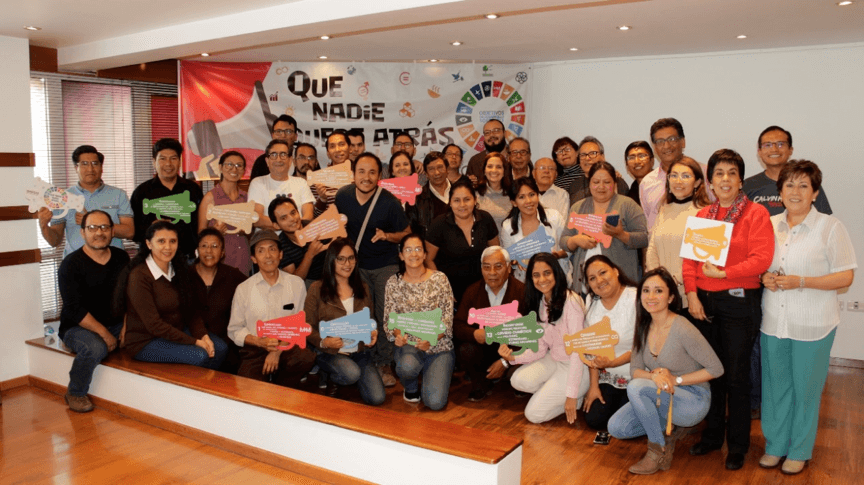
Based on the development of a methodological tool with a popular education approach known as “Human Rights and Sustainable Development Goals. A Guide for Training – Participatory Action”, within the context of a political crisis due to national elections in Bolivia, representatives from Bolivian NGOs and networks from eleven countries in the region (Honduras, Paraguay, Venezuela, Nicaragua, Guatemala, El Salvador, Bolivia, Uruguay, Colombia, the Dominican Republic and Chile) together with representation from MESA de Articulación, met on the 28th, 29th and 30th of October 2019 to participate in the “Popular Education, Human Rights and Regional SDG Course.” Since this meeting, a call has been made for articulation and joint working among the participating CSOs, whose mapping revealed an unfavourable environment for the CSOs due to violations of their fundamental rights. The voices were:
Democratic Institutionalism and Governance
“Information is needed to take action and make decisions. Information is not enough if the transformation of society is not the aim.” “We understand governance to mean democratic political dialogue, accountability, concrete results in the development of human rights, ethics in political action and joint and articulated action in the defence of these rights.” “A right that is not exercised is a right that is lost.” “Advocacy requires social dialogue and political dialogue with the inclusion of diverse voices. Access to CSO information is essential.” “We must have a stable democracy to move forward with the 2030 Agenda.”
Human Rights and Development
“There is progress, but we still have a long way to go before human rights can be fully exercised.” “The 2030 Agenda enables us to look at ourselves with more universal objectives for everyone.” “The voice and action of CSOs is vital for demanding the fulfilment of the commitments signed by the States. When it comes to making these demands, many people are being persecuted and, on some occasions, have paid the price with their lives.” “Our leaders’ and rights defenders’ right to life is not being guaranteed in our countries.”
“Many of our organisations are still not incorporating the SDGs into our activities. Ideally, we should start fighting for everything we have discussed in the last three days: we have to achieve results by the year 2030.” “We will improve our voice, coordinate to lead a Development Agenda, and move forward and look at how to implement the SDGs.”
The interaction which highlighted diverse and different voices was presented in a video called “QUE NADIE QUEDE ATRÁS” (DON’T LET ANYONE BE LEFT BEHIND). Without the support of Forus, this process of strengthening the CSOs in Latin America and the Caribbean would not have been possible.
The methodological guide and the video can be accessed using the following links: