© NGO Forum on ABD
© Forus
Sat 19 Jul 2025
Forus members call for radical reforms at HLPF 2025
July 19, New York - As the world enters the final five year-sprint towards achieving the 2030 Agenda, Forus and its members are sounding the alarm - and offering a path forward.
At the ongoing UN High-Level Political Forum in New York the Forus network started the day on July 18 with the virtual launch of the new Forus report: “Unlocking the power of localization and multi-stakeholder partnerships to rescue the SDGs”. With contributions from across 20 Forus members and a panel discussion with representatives from CODE-NGO (The Philippines), CONGCOOP (Guatemala) and TANGO (The Gambia), the session moderated by VANI (India) and launched by Forus Director Sarah Strack looked at stories and experiences on localisation processes and efforts across the network.
"With just five years left to 2030 and only 17% of SDG targets on track, we face a convergence of global crises threatening to derail progress. Yet, hope lies in localisation — in the power of communities, inclusive partnerships, and the innovation of local actors who are already driving resilience and results," said Jyotsna Mohan Singh, Advocacy Officer at Forus and Lead Author of the report.
"As Alicia Bárcena reminds us, the 2030 Agenda must be our opportunity to transform development — toward equality and sustainability,” said Alejandro Aguirre Batres, Executive Director of CONGCOOP, Guatemala. CONGCOOP supports Indigenous and rural communities in strengthening their political participation through civic education, participatory budget monitoring, and social audits. These efforts aim to hold public authorities accountable and promote transparency in development spending.
Their work goes beyond monitoring: they also advocate for progressive tax reform in Congress and highlight the insufficient taxation of elites as a structural barrier to financing sustainable development.
Ndey S. Bakurin, Executive Director of TANGO, The Gambia, shared TANGO's Role in SDG localisation. TANGO advocates for civil society by representing CSOs in National Steering Committees and technical bodies, ensuring their voices influence policy. It engages government stakeholders to strengthen civic participation in development planning. To promote collaboration, TANGO convenes multi-stakeholder meetings on the SDGs, supporting dialogue between CSOs, government, and development partners — including during key events like the Summit of the Future.
For instance, on SDG 5 (Gender Equality), “TANGO supports a comprehensive response to gender-based violence (GBV), including legal representation and access to justice. It promotes sexual and reproductive health and rights (SRHR), economic empowerment, and livelihoods for women and girls. TANGO also leads social and behavioural change campaigns, builds the capacity of community-based CSOs, and provides technical and financial support for grassroots initiatives. Additionally, it works to strengthen data collection systems to better monitor progress on gender equality,” shared Ndey S. Bakurin, Executive Director of TANGO.
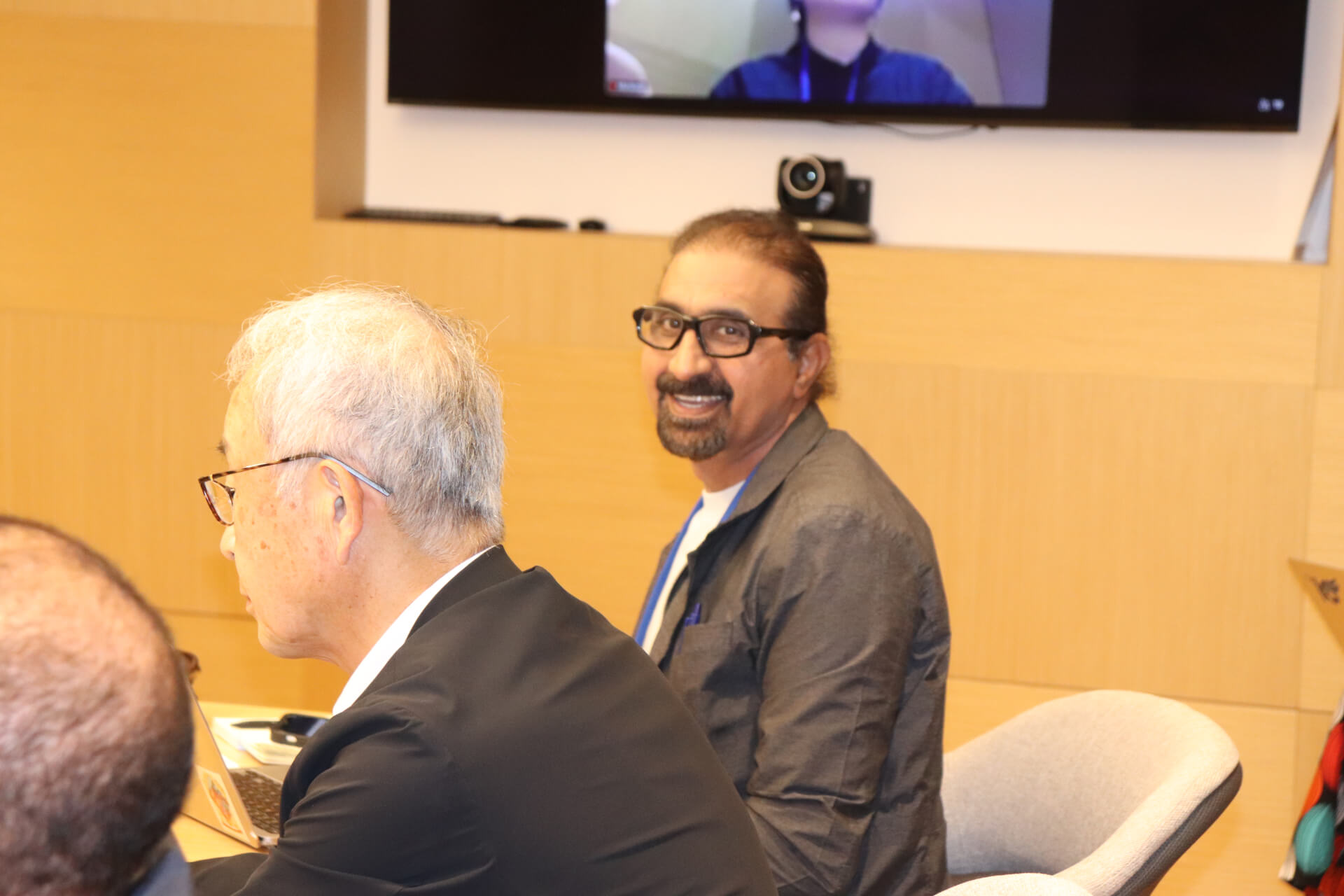
The event set the stage for a dynamic conversation about how civil society leaders can work together towards Agenda 2030 at the event "CSO Engagement in Voluntary National Reviews – Focus on SDG 16 & 17" spotlighted insights from several Forus members such as NNNGO (Nigeria), ADA (Asia), PDA (Pakistan), and INFID (Indonesia) and was chaired by Zia Ur Rehman, from the Asia Development Alliance.
“We must rethink the global aid system” – Zia Ur Rehman (ADA)
Zia offered a powerful critique of global funding priorities, highlighting how distorted financial flows from South to North are undermining development:
“There is an excessive amount of funding going from the Global South to the North for armament- that could be used for SDG implementation.”
“On average, Asian governments spend just 6-8% of GDP on the SDGs - that's not enough.”
“Debt servicing is the other big challenge. The amount spent on repaid debt could provide basic health and education. We need to rethink the global aid infrastructure system - it is non-democratic and exploitative.”
His call to overhaul international financial flows echoed a growing frustration among CSOs about the lack of democratic decision-making and accountability in the SDG process.
“Voluntary National Reviews must become tools of truth, not symbolism.” – Oyebisi Oluseyi (NNNGO)
In his intervention, Oyebisi Oluseyi, Executive Director of the Nigeria Network of NGOs (NNNGO), drew on key findings from the newly released Forus report which looks at 10 years of Voluntary National Reviews (VNRs) – what worked and what hasn’t.
“As we approach the final five years of the 2030 Agenda, we must ask: Are voluntary national reviews driving real accountability and progress, or are these symbolic exercises?”
From an analysis of 366 VNRs submitted since 2016, the report reveals:
-
A decline in submissions, from 47 in 2019/2020 to just 36 in 2024.
-
Inconsistent integration of SDGs into national planning.
-
A dramatic lack of civic space and enabling environment for civil society reporting, with only 1 of 42 VNRs in 2021 mentioning shrinking civic space.
-
Tokenistic inclusion of CSOs, with engagement often conducted but not reflected in outcomes.
Oyebisi warned that without genuine civic engagement and public accountability, the SDG monitoring and evalutation process risks becoming a performative exercise.
What is working - what needs to change
The Forus report highlights several promising examples:
-
Sri Lanka: improved VNR outcomes through twinning programmes.
-
Uruguay: cross sectoral VNRs engaging parliament, CSOs and private sector.
-
Canada and Chile: strong localisation strategies with active local government participation.
But these examples remain exceptions - not the norm.
Forus and its members propose 5 key recommendations to rescue the SDGs:
-
Institutionalise CSO engagement: formally include civil society, recognise shadow reports and show how feedback shaped outcomes.
-
Mandate independent reviews: VNRs should include external validation and data triangulation.
-
Unlock commitment tracker: countries must report annually on actions taken post-VNR.
-
Expand data sources: use disaggregated and citizen-generated data to reflect all communities.
-
Localise VNRs: scale voluntary local and subnational reviews to bring SDG implementation closer to the people's lives.
“If we fail to reform the VNR process now, we risk repeating old mistakes - delivering more reports than results,” Oyebisi concluded.
And as Zia reminded the room, “without democratic financing and civil society inclusion, the SDGs are a broken promise.”
The Forus network message at the HLPF is clear:
Unlock local power. Rebuild partnerships. Rescue the SDGs.
Read the newly released Forus report here
/ Reports & publications
Thu 17 Jul 2025
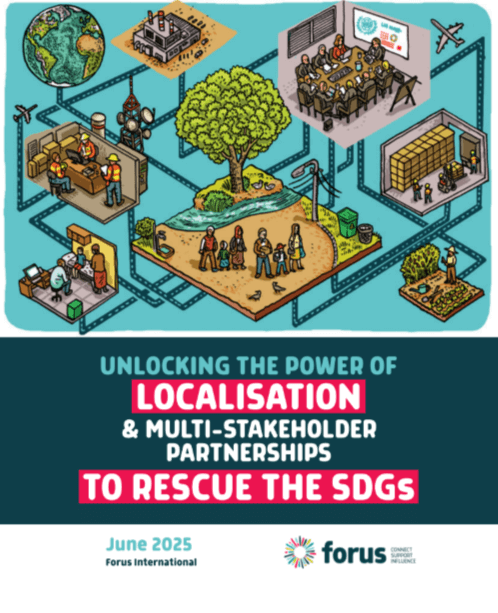
Unlocking the power of localisation and multi-stakeholder partnerships to rescue the SDGsDiscover 15+ powerful case studies from across five regions in the Forus network, showcasing how local communities are reshaping the path to achieving the Sustainable Development Goals (SDGs). This groundbreaking report offers practical strategies to reorient SDG implementation from the ground up — prioritising inclusive, locally driven, and community-owned approaches.
Wed 16 Jul 2025
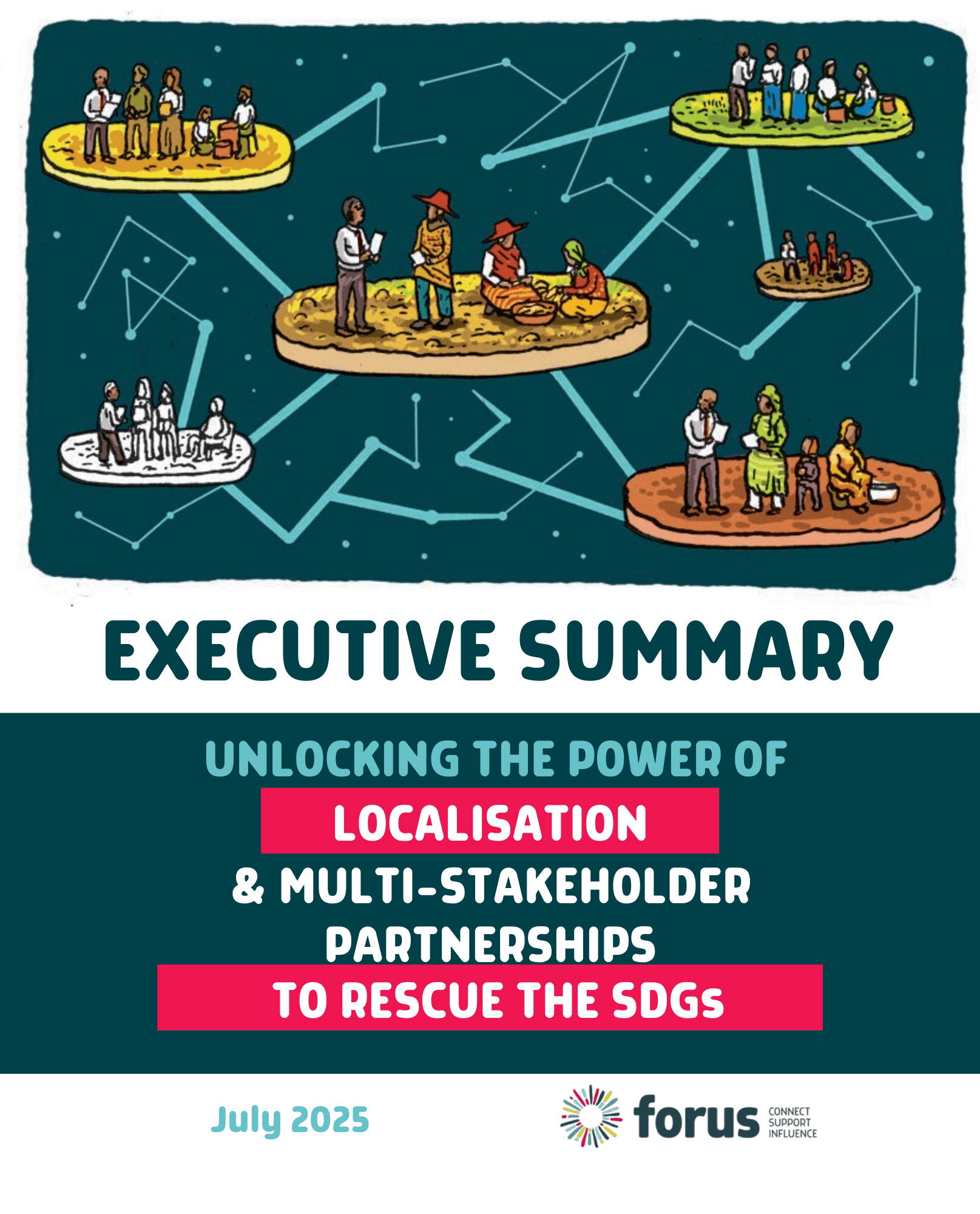
Executive Summary - Unlocking the power of localisation and multi-stakeholder partnerships to rescue the SDGsThe Executive Summary of the "Unlocking the Power of Localisation and Multi-Stakeholder Partnerships to Rescue the SDGs" report presenting over 15 powerful case studies from across five regions in the Forus network, showcasing how local communities are reshaping the path to achieving the Sustainable Development Goals (SDGs). By centering local leadership and multi-stakeholder collaboration, the report highlights transformative pathways to rescue the SDGs and build more resilient, equitable societies.
Tue 15 Jul 2025
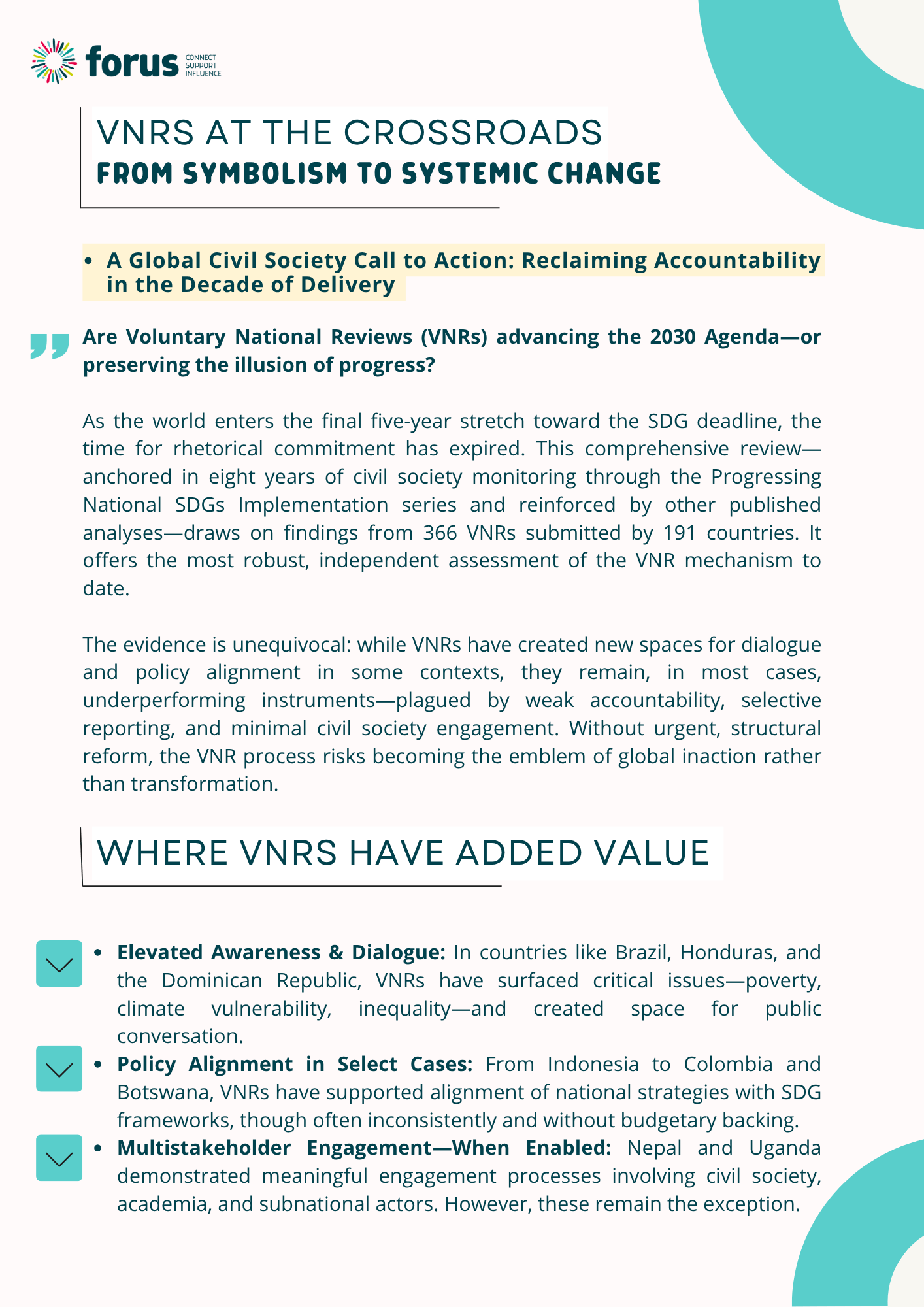
VNRs at the Crossroads - From Symbolism to Systemic ChangeAre Voluntary National Reviews (VNRs) advancing the 2030 Agenda—or preserving the illusion of progress? As the world enters the final five-year stretch toward the SDG deadline, the time for rhetorical commitment has expired. This comprehensive review—anchored in eight years of civil society monitoring through the Progressing National SDGs Implementation series and reinforced by other published analyses—draws on findings from 366 VNRs submitted by 191 countries. It offers the most robust, independent assessment of the VNR mechanism to date.
Thu 10 Jul 2025
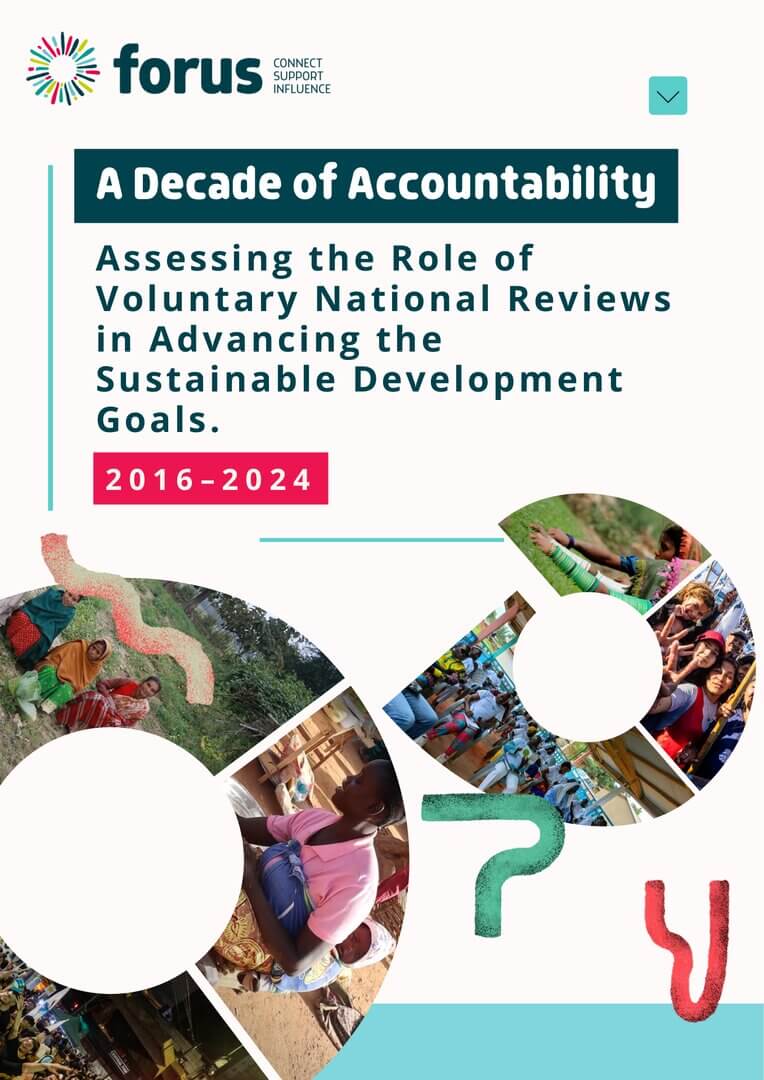
A Decade of Accountability - Assessing the Role of Voluntary National Reviews in Advancing the Sustainable Development Goals.Since their inception in 2016, Voluntary National Reviews (VNRs) have served as a key accountability tool for monitoring progress on the Sustainable Development Goals (SDGs). Designed as country-led and voluntary mechanisms, VNRs aim to peer learning, track national progress, and identify policy gaps, ensuring that governments remain accountable to their commitment to the Agenda 2030. In this report we assess both what has worked and what hasen't in these past 10 years with case studies from national platforms across the Forus network.




Join our campaigns!
Discover our campaigns on shifting power and new forms of financing for development