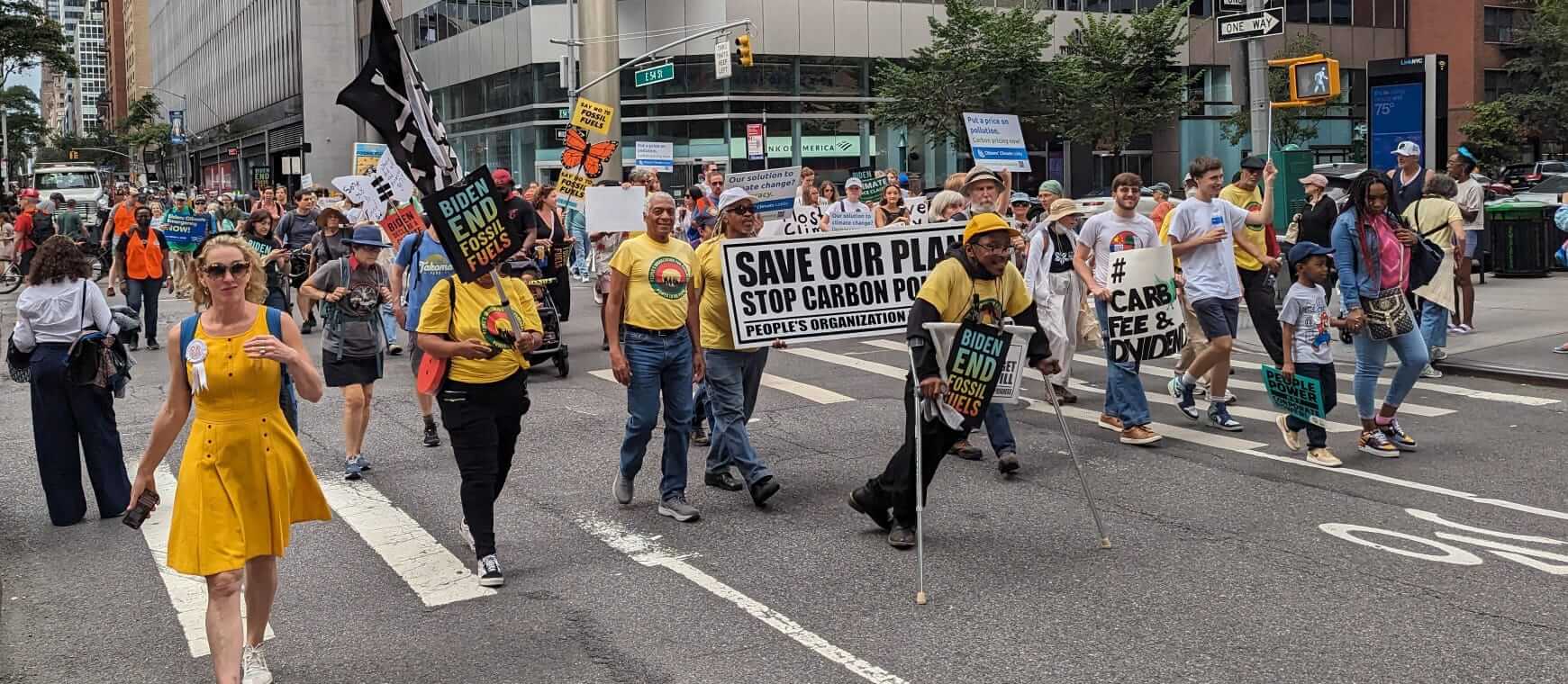
©Climate March New York - Forus


2023-10-06
Forus Members’ Engagements During 2023 SDG Summit
In anticipation of the SDG Summit and UNGA, several Forus members engaged in direct collaborations with their respective governments to discuss the outcomes of their country’s efforts in the implementing the Sustainable Development Goals (SDGs) at the national and local levels. They also convened meetings with their country’s UN delegations in New York.
La Coordinadora de Organizaciones para el Desarrollo in Spain underscored the pivotal role the Spanish government could have played, as it presided over the Council of the EU during the SDG Summit. This unique position provided an opportunity to champion ambitious commitments and European policies centered around people and the planet at the center, fall within a framework of policy coherence for sustainable development.
POJOAJU - Asociación de ONGs del Paraguay brought together their members and partners under the banner of their initiative “CSOs strengthening capacities for monitoring public policies through analysis and debated on the state of the #SDGs with a rights-based approach.” Meanwhile SPONG, the Burkina Faso NGO network, succesfully participated in the High-Level Political Forum in July 2023 and collaborated with their members to engage around the UN General Assembly.
Some members launched their own reports assessing the progress of SDG implementation in their respective countries. ACCIÓN, the Chilean NGO Association,recently released the "Spotlight Report (Informe Luz) 2023 on the Implementation of the 2030 Agenda in Chile", in partnership with other organizations. In the UK, Bond collaborated with Newcastle University and the Bond SDG Working Group to publish an analysis of the UK’s response to the SDGs in 2023. Meanwhile, CONGCOOP, the national platform of NGOs in Guatemala, published an alternative report on the implementation of the SDGs in the country. Alejandro Aguirre Batres, the organization’s Executive Director, emphasized the stark divide in Guatemala between a privileged minority benefiting from macroeconomic stability and a majority grappling with poverty and inequality. “In Guatemala, there are two worlds, one for a small group that benefits from this macroeconomic stability, this weakness of democracy, this co-optation of state institutions, and a large majority of the population that faces poverty and inequality.”
For some, the need arose to launch campaigns advocating for increased government commitments to the SDGs and participation at the New York SDG Summit and UNGA. In the UK, Bond, alongside over 100 leaders of UK NGOs, urged Prime Minister, Rishi Sunak to attend the in September as part of the UN General Assembly and endorse the negotiated SDG Political Declaration. UN SDG Summit in September as part of the UN General Assembly and endorse the negotiated SDG Political Declaration.
As we approach the halfway mark of the 2030 Agenda, Jyotsna Mohan Singh, representing the Asia Development Alliance, emphasized that although the SDGs look good on paper, their real-world implementation falls far short of expectations. She called for governments to develop a coherent roadmap for sustainable development with time-bound targets, stressing the importance of creating inclusive spaces for civil society and stakeholders to engage with local communities. “Governments should develop a policy coherence for sustainable development roadmap with timebound targets,” she explained, adding that it’s all about creating spaces grounded in equity where civil society and other stakeholders can join discussions and connect with local communities.
José Ramon Avila, Executive Director of ASONOG - AsociaciónAsociacion De Organismos No Gubernamentales, the national platform of NGOs in Honduras and Forus Council member, condemned the UNGA speech by the President of Honduras for for neglecting the country's commitment to environmental preservation, energy transition, and the reduction of extractive practices. “[The President's discourse] leaves aside the commitment of the country and the region to stop environmental degradation, the demand and commitment to the energy transition and the advance of extractivism.”
Zia ur Rehman, National Chairman of the Pakistan Development Alliance, strongly advocated for the localization of SDG implementation at various side events during the UN General Assembly. He emphasized the need to bring SDG processes to the grassroots level to develop successful strategies for human development and empowerment. Additionally, he called on Pakistani authorities to safeguard and promote civic space in the country, highlighting the government's inability to provide reliable data on priority indicators for measuring SDG progress. “Pakistan is failing to achieve SDGs due to disengagement with civil society and other stakeholders. Ironically, the government is unable to provide reliable data on any of their own priority indicators to measure progress towards the implementation of SDGs, particularly on rights-based indicators” . Their newly published Pakistan Civic Space Monitor reveals a generally restricted civic space, including restraints on freedom of speech, assembly, information, rule of law, governance, and public participation, with further deterioration.
To further champion the achievement aof the SDGs by 2030, several Forus members and civil society leaders called for unity and collaboration among civil society organisations. They urged for the sector to unify its strengths and work on joint solutions and strategic thinking to push for the implementation of the SDGs.
“Civil society organizations need to break the silos and mobilize for more targeted advocacy to act for the SDGs,” said Oyebisi, B. Oluseyi, Executive Director of The Nigeria Network of NGOs (NNNGO) at a side event.