© Forus
2025-12-08
Forus Virtual Forum 2025: Built for This Moment, Ready to Shape What Comes Next
The 2025 Forus Virtual Forum (FVF) brought together member platforms from across Africa, Asia, Europe, Latin America and MENA for three days of collective reflection, strategy-review, and network weaving. Held at a decisive moment for civil society worldwide, the Forum offered a powerful reminder of what makes the Forus network unique: shared values, shared vision, and our call as platforms of civil society organisations to mobilise people power and stand in solidarity and connect.
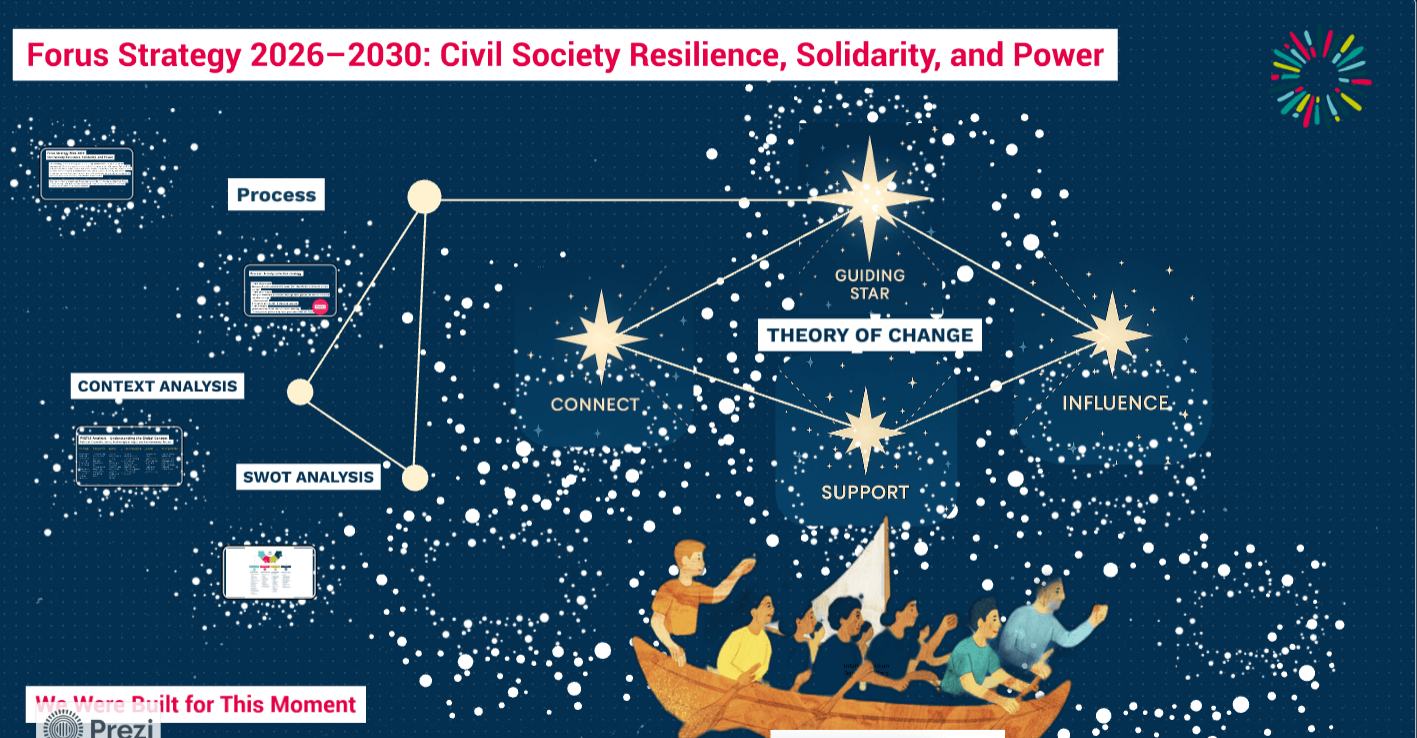
Across its four sessions — Support, Influence, Connect, and Network Health — the Forum created a space for members to reconnect, reflect on 2020- 2025 achievements, and discover how the new 2026–2030 strategy will come to life.
Despite global disruptions and a shrinking enabling environment, the Forum demonstrated that the network is not only adapting — it is evolving with renewed energy.
Session I — Support: Strengthening Capacities, Solidarity and Collective Care
Day one focused on Forus’ Support Pillar and how member platforms can better navigate political, operational and financial pressures. Members exchanged experiences on: organisational resilience, leadership development,digital transformation and peer-driven solidarity mechanisms.
The session highlighted how support cannot be reduced to training or funding; it is an ecosystem of political, technical, emotional and collective forms of care. Members shared the ways in which Forus’ leadership development programme, financial cycles, and digital capacity-building tools have strengthened their ability to operate in hostile environments.
The conversation affirmed a shared priority for the years ahead: balancing immediate crisis needs with long-term organisational sustainability.
Session II — Influence: From Evidence to Collective Power
The second day was marked by the official unveiling of the new five-year strategy on Civil Society Resilience, Solidarity and Power (2026–2030), followed by an in-depth discussion on ow members can collectively activate the Influence Pillar.
Members reflected on what it means to protect and expand civic space at a time of: political repression, rising authoritarianism, declining official development assistance, digital threats, and shrinking civil society participation in global decision-making spaces at both national and global levels .
Rich regional examples showcased how evidence is becoming a central tool for influence: from EU SEE data strengthening national advocacy responses in Nepal and Paraguay, to coordinated civil society action at the Finance in Common Summit that secured civil society space on global stage, to shaping conversations on global financing for development, the Sustainable Development Goals (SDGs) with currentand post-2030 agenda, rooted in lived experience from across the network.
The discussions reaffirmed that Forus’ influence must remain member-led, evidence-driven, and globally connected, bridging local realities with global debates.
Session III — Connect: Strengthening the Ties That Make Us a Network
Day three highlighted the Connect Pillar — the backbone of collaborative infrastructure, relationships, and collective intelligence across Forus. Members explored new multilingual communication tools, peer-learning ecosystems, cross-regional solidarity mechanisms, and the practical challenges of navigating fragmented civic ecosystems.
Members shared their own experiences with national coordination, digital communication, regional collaboration, and knowledge exchange — from Africa to Asia to the Pacific.
The conversation underscored a key insight of the new strategy: connection is not a by-product of the network — it is the work.
It was agreed a more intentional, agile and inclusive approach to connectivity will be essential for the next five years.
Session IV — Network Health: The Foundation of a Strong and United Movement
The final session introduced Network Health, the new strategic pillar designed to sustain the relationships, trust, governance and internal systems that make Forus a living, breathing network.
Members were invited to reflect on inclusive governance, internal communication, organisational resilience, fairness in participation, and the importance of network weaving.
Insights from the social network analysis, showing how connection patterns reveal opportunities for stronger collaboration and help identify bottlenecks or underconnected regions were also discussed. The session also featured a concrete case study from Ireland on using network mapping and membership portals to enhance coordination and visibility.
This final day affirmed that network health is not an add-on — it is a strategic priority that will make or break collective action in the years ahead.
FVF 2025 in Summary: A Network Ready for the Next Chapter
The Forus Virtual Forum demonstrated:
- high engagement across all regions,
- deep reflection on shared challenges,
- collective ownership of the 2026–2030 strategy,
- and a readiness to activate the next phase of global civil society collaboration.
Members described the sessions as energising, substantive, and future-oriented.
Discussions showed a network committed not only to reacting to global pressures, but to shaping new possibilities.
As the Forus network moves toward the General Assembly in Cambodia in 2026, the momentum generated across these four sessions makes one thing clear: Forus is entering its next strategic cycle stronger, more connected, and more united than before.
The world is changing fast — but so is civil society. And together, we are built for this moment.