2021-07-27
From local to global: the importance of a free civil society in the Democratic Republic of Congo
News

By the CNONGD, Forus member in the Democratic Republic of the Congo
The CNONGD (Conseil National des ONG de développement) is a Congolese umbrella body of development NGOs that was set up in 1990 with the aim of overseeing advocacy and strengthening measures in support of democracy and good governance. It is an expression of willingness from the volunteer organisations committed to development, to better assist with the country’s democratisation efforts and the coordinated development of local communities.
The activities offered by the CNONGD and its members are part of a global strategy that is centred around the following themes:
- Organisation of synergetic CSO advocacy action;
- Internal stakeholder engagement;
- Organisational, managerial and technical capacity development.
The “Journée Nationale d’Engagement Politique” (JNEP) or “National Political Engagement Day” is at the heart of CNONGD’s political strategy. It is a mechanism that promotes the participation of Congolese CSOs in governance processes.
The JNEP seeks to transform the “subservient civil society” in DRC into a “free civil society”, supported by professional associations, youth movements, women’s associations, trade unions, religious communities, human rights associations and a branch of credible and legitimate NGOs that instil an accountability culture, are truly dedicated to the community, and provide proof of a clear command of their approaches to work as well as a proven ability to influence politicians.
The capacity development measures implemented as part of the partnership with Forus focused on updating local actors on advocacy and lobbying that are directly linked to the SDGs; social engagement, negotiation techniques and partnership management. The advocacy and lobbying update focused on practical advocacy for results as part of the promotion of freedom of association. The steps, tools and skills required to conduct this so-called advocacy have been outlined.
A successful partnership involves a good mutual understanding. A partnership enables you to share your knowledge, concerns and experiences; it enables you to exchange views. The key points were underlined: the founding principles of the partnership; different types of partnerships; partnership tools; different partnership levels and the partnership follow-up.
Most CSO activities end with very few tangible/palpable results and also do not lead to genuine transformations in their economic, political, social or institutional environments.
A particular emphasis was put on the module pertaining to SDGs, since almost 70% of DNGOs/CSOs were unaware of the SDGs and the National Strategic Development Plan until now. The same is also true for other stakeholders (political authorities, local leaders, etc.). These stakeholders continue to set up programmes that do not have clear links to the SDGs and the PNSD.
In order to work effectively in achieving the SDGs through the local promotion of the SDG action plan, the following is required:
- Knowing and understanding them;
- Using local actors;
- Prioritising according to the local needs;
- Identifying what could be done to better implement them.
For the CNONGD, the local actors update is not only aligned with its capacity development strategy, but also with a global initiative, such as the accomplishment of Agenda 2030.
An SDG/PNSD technical team is put in place in every regional council. This technical team will gradually progress to an independent SDG monitoring centre.
The SDGs will only be achieved if they have local, sound and pluralistic roots.
The CNONGD is convinced of the importance of capacity development on a local level for the community to get involved in the process and the implementation of the SDGs. The development fundamentals are on local terms and the development of current capacities.
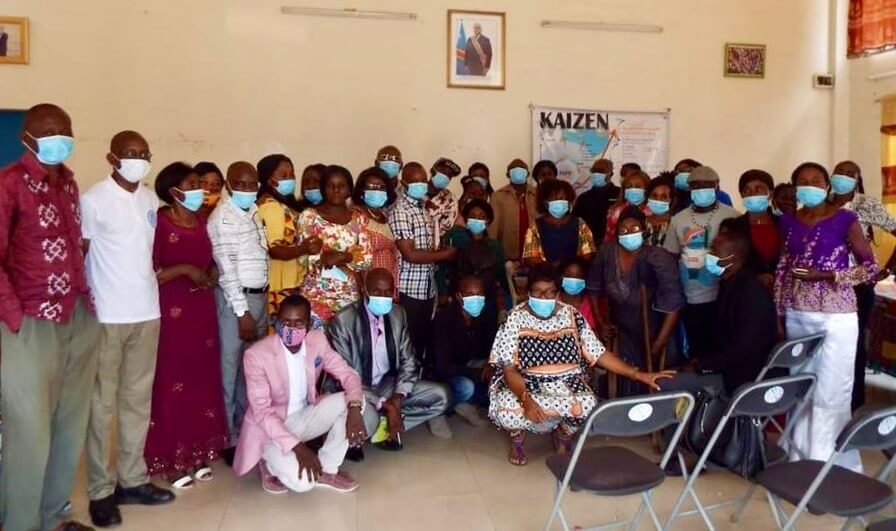
Photo: project in Gemena, DRC.