Tue 14 Apr 2026
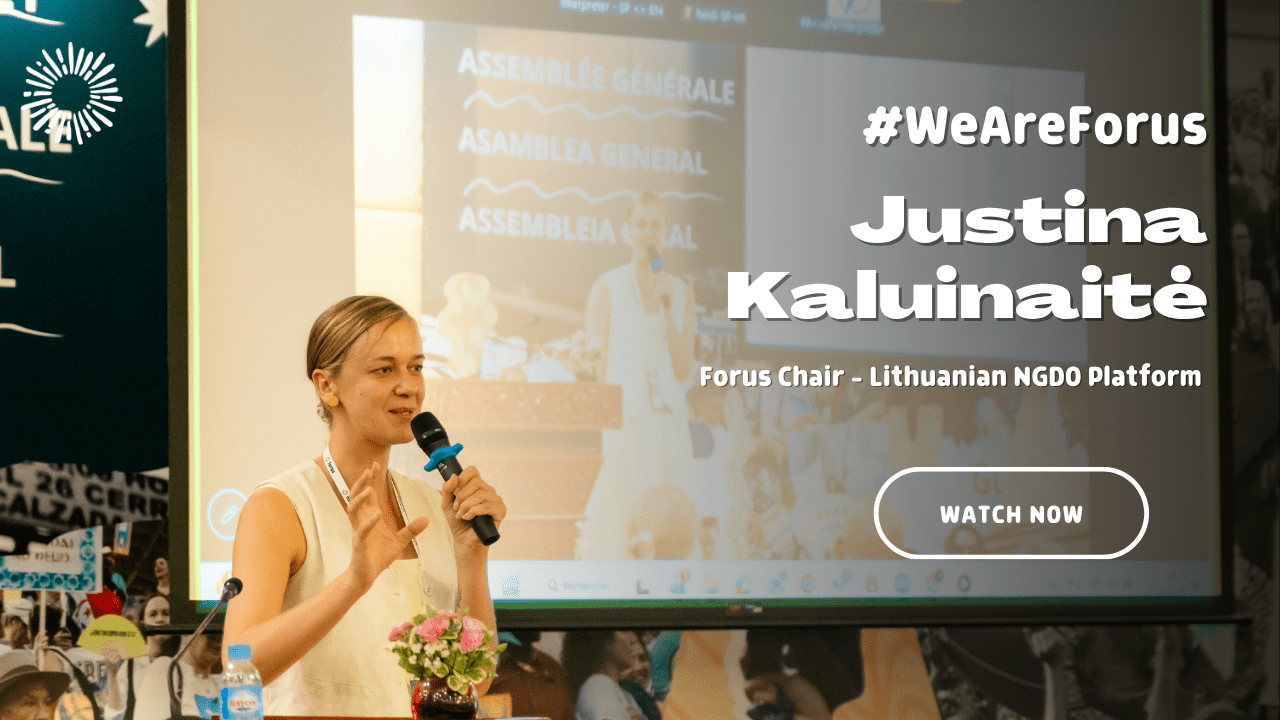
In Conversation with Forus new chair Justina Kaluinaite
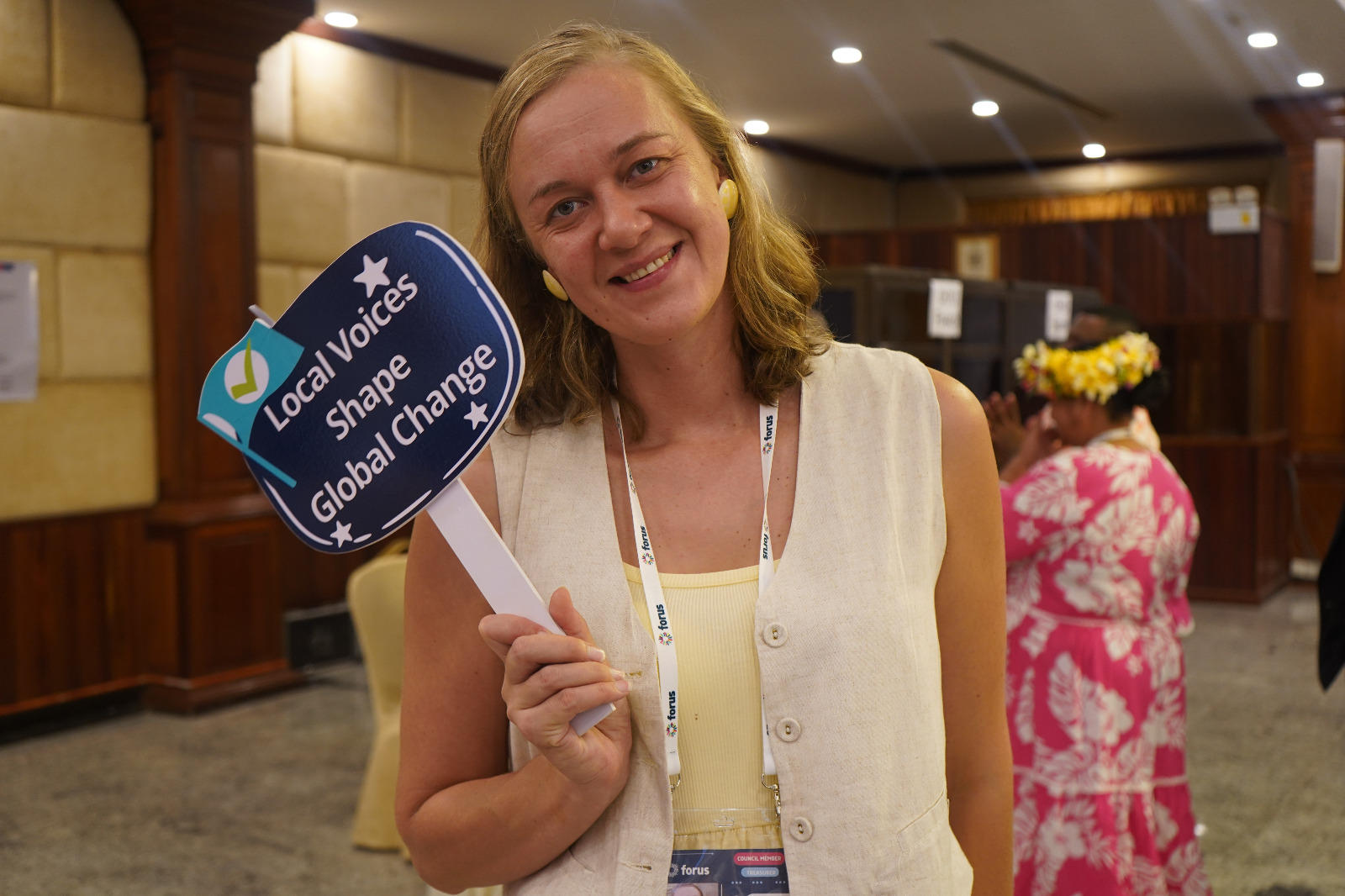
At the Forus General Assembly which just concluded in Cambodia, members of the global network elected Justina Kaluinaite as new Chair. Kaluinaite brings experience focusing on socio-education community development in post-conflict phrases, trauma-aware development processes, effective development cooperation and humanitarian action management. She has over a decade of experience in various CSOs and community development entities, academic placements in Lithuania and globally. Bringing perspectives from her work in Rwanda, Cambodia and Colombia (among others) and working for a decade with the Lithuanian Development Cooperation Platform (Lithuanian NGDO Platform), she brings a global, empathic and strategic perspective to her new role.
We sat down with her for a conversation about what her new role means, the challenges facing civil society today, and her vision for Forus.
Q: Congratulations on your election as the new Chair of Forus. How does this make you feel, and what are your immediate priorities?
A: It is both an exciting new chapter and an honour — and a lot of happiness, too. This is not just a position for me, it is a responsibility entrusted to me by a community that believes in justice, dignity, and the power of collective action.
For a long time, we, as civil society had to navigate multiple complex challenges, often pushed to the limitations we face in the rapidly changing world around us. Now more than ever we must focus on what we can build together. As Chairwoman, I want to focus on close supportive working, looking at all the voices within Forus, make sure everyone is heard, and find ways to mobilise what we have collectively. Our strength lies not just in numbers, but in our ability to speak and act together to create lasting values and drive social change.
Across diverse contexts, I have consistently been inspired by our ability to connect people and organisations, to bridge distances, and to transform individual efforts into collective strength. This is where I see the true power of Forus: in its capacity to link voices across regions and to turn collaboration into meaningful global impact.
I am committed to strengthening our work in advocacy, ensuring that our collective voice is not only present, but influential in shaping agendas. At the same time, I believe deeply that our effectiveness depends on our wellbeing as a network. We must continue to build an environment where people feel supported, valued, and able to grow.
Q: Lithuania sits at the front line of European security debates. How are Lithuanian CSOs contributing to peace and stability locally and regionally amid rising geopolitical instability?
A: Security is not limited to military concerns alone. What I also recognise—and value greatly—is the growing emphasis on mental awareness, societal resilience, and the strengthening of civil society itself. In Lithuania, we have begun to take these broader dimensions of security seriously, placing civil society at the center of our response and preparedness efforts.
Of course, we are deeply affected by the tensions in our region. But that also makes our voice richer when it comes to these conversations. We know what is at stake, and we bring that lived understanding to the table.
Q: How is the Lithuanian NGO platform assessing the current state of civic space? What specific risks or pressures are CSOs facing today?
A: There is a tendency — and we see this a lot — where people say: ‘We don’t have enough military equipment, so nothing else matters.’ That framing is dangerous, because it sidelines everything else, including international cooperation and civil society engagement. But what I am proud of is that, as a society, we have not accepted that framing. We acknowledge disinformation, we address bad facts, and we continue prioritising civil society's inclusion in policy — because in any functioning system, you need civil society at the table.
“There would be nothing without civil society. It is that simple.”
Q: What forms of cross-border collaboration between CSOs have proven most effective in responding to shared challenges — disinformation, civic space backsliding, and demographic pressures?
A: One thing I always come back to is that just 20 years ago, Lithuania changed from being an aid recipient to a donor country. That journey gives us a very specific kind of knowledge — we know from practice how democratic processes work, because we lived through building them. And those things do not just happen. It takes a lot of networking, a lot of work, and a lot of trust.
We have very close cooperation within the Baltic countries — Lithuania, Latvia, Estonia. We feel like brothers and sisters, because we face the same regional challenges and have achieved a great deal together. That’s where my passion for the power of connection comes from. My strong focus on networking comes from seeing that civil society’s impact is not only about what organisations do individually, but how effectively they are connected. When we cooperate through strong networks, we become faster, stronger, and more resilient in responding to shared challenges.
“As a Lithuanian platform, we could barely touch the disinformation machine on our own. But as a region, we can do much more. And I think that feeling — of working together but also having a sense of family — is what makes it powerful.”
That is also what I find here at Forus. That same feeling of doing a lot of work together, but also genuinely caring for one another. It genuinely means a lot to me and it is what allows us to tackle the big challenges.
Q: Economic, humanitarian and security pressures are testing the resilience of civil society. What strategies have Lithuanian NGOs adopted to maintain operational continuity and protect their advocacy role during crises?
A: One key focus has been building stronger networks and coalitions. Rather than working in isolation, NGOs in Lithuania increasingly coordinate responses through platforms and umbrella structures, allowing them to share resources, align advocacy, and respond more quickly during crises—especially in the context of regional security concerns and the war in Ukraine. We as human beings do not live in the vacuum, so as civil society we also cannot face the challenges alone.
What I believe — and what I told the Forus colleagues—we are all experts in what we do, and there are so much knowledge, experience and capacities to share. In those emergency moments, that is where we come together even stronger.
“I also focus a great deal on well-being — the well-being of NGO workers, the pressure they face. That is an important place where we need to put our attention, especially for those working on the front lines.”
Beyond the humanitarian response, I think it is vital that civil society secures its place in political and security decision-making — not just as service providers, but as real partners. And that is only possible if we cooperate: with governments, with academia, with other sectors.
Q: How is the Lithuanian NGO platform supporting its members to strengthen public trust, mobilise citizens and protect meaningful participation in democratic processes, at a time when polarisation and external influence are increasing?
A: We work with our members on several levels: capacity building, communications training, advocacy, networking, and peer-to-peer learning. But underpinning all of it is one core conviction — civil society must be clearly understood by the public. We have expert people. We are professional organisations. We contribute enormously to society. And we need to be able to say that clearly, in a way that different audiences can hear.
But just as important as speaking out is listening and channeling. We want our members to be the channel — bringing the voices from the ground into decision-making processes, into advocacy, into the rooms where things are decided.
“My vision for Forus does not only come from me as a person. It comes from all of us, our organisations working on the ground. My role — and Forus’ role — is to make sure those voices are heard, and spaces for our collective power created.”