©Activist in Mexico. Melania Torres/Forus
Wed 12 Jul 2023
New Forus Report: “Sustainable Development by Shifting the Power”
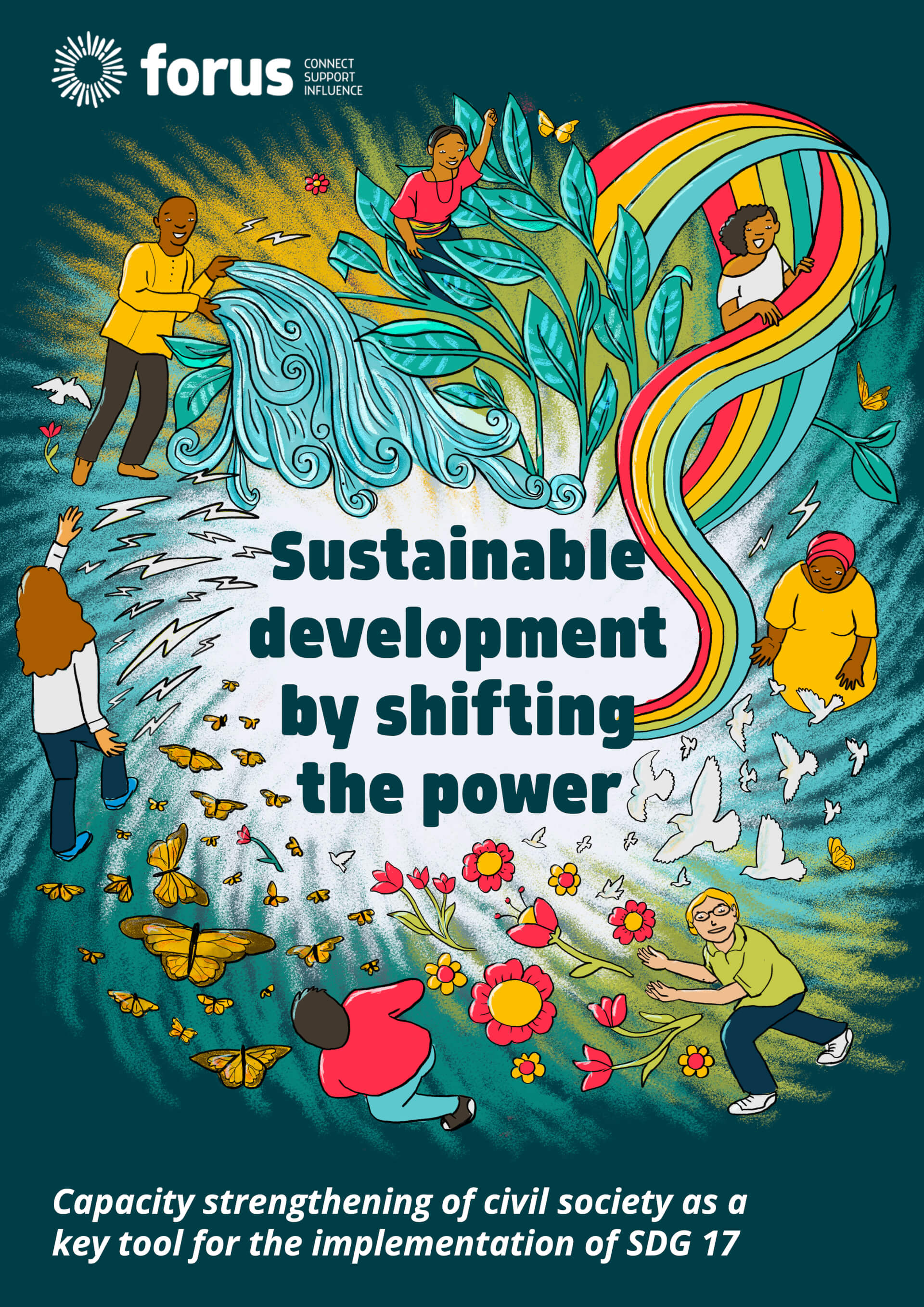
The Forus network launched a new report at the 2023 United Nations High Level Political Forum, titled “Sustainable Development by Shifting the Power: Capacity Strengthening of Civil Society as a Tool for the Implementation of SDG17”.
The report co-created by 14 Forus members from different regions and contexts, calls for transformative changes in the international development sector, with a focus on power dynamics, localization, and decolonization. It highlights the crucial role of civil society organizations in advancing the Sustainable Development Goals (SDGs) and stresses the importance of capacity strengthening initiatives that are driven by the needs and priorities of CSOs themselves. The report also provides recommendations to relevant stakeholders and reaffirms the commitment to support CSO capacity strengthening and foster inclusive practices.
The online launch event gathered 54 participants and 6 panelists from various Forus member organizations and partners around the world. They shared their insights and experiences on how to strengthen the capacities of CSOs and enhance their participation in decision-making processes.
From Aid to Cooperation
Lina Paola Lara Negrette from the Confederación Colombiana de ONG (CCONG), said during the launch: “CSOs should be given more autonomy to identify and address their own capacity strengthening needs.” Moses Isooba, Executive Director of the Uganda National NGO forum (UNNGOF), agreed:
“Capacity development should not be dictated by donors. Capacity gaps are better known and better addressed by CSOs. CSOs need to play the leading role in capacity development. Everybody has got a voice but only a few of us have a microphone, it's time to listen to capacity needs and to address them differently.”
Many CSOs face the challenge of aligning their work with the donors' agenda, which may not reflect the local needs and realities. This is especially true for organisations working on human rights and civic justice, which are losing local funding spaces to international agencies.
Pedro Bocca, International Advocacy Advisor for Abong, Brazil, called this "a weapon of colonization" and urged for a shift from aid to cooperation. “National funding spaces are colonized by international funding agencies. Local CSOs are suffering as a result,” Zia Ur Rehman, National Chair of the Pakistan Development Alliance (PDA) added.
Transparency and Accountability
To address this challenge, some CSOs suggested bringing accountability to the centre.
“We must advocate for global, national and regional level indicators that are linked to SDG17 which can help us effectively measure the extent to which capacity strengthening for CSOs and other stakeholder groups is happening,” Oyebisi Oluseyi, Executive Director of the Nigeria Network of NGOs (NNNGO), said.
Oyebisi urged governments to report their spending on CSO capacity strengthening annually. “We want this to be mandatory and publicly available to promote transparency and accountability.”
“Accountability and transparency should be the basis of all the approaches. There is the need for greater awareness on public interest functioning, holding governments accountable and the advocacy for marginalized and excluded groups,” Jyotsna Mohan Singh, Regional Coordinator of the Asia Development Alliance (ADA) contributed. She stressed the importance of civic space and participation for ensuring effective development outcomes.
Decolonisation and Power Shift: "Solidarity requires new measures & approaches"
Pedro Bocca argued that the current financial system is based on unequal power relations and does not address the needs of civil society – especially of those working at local level with communities.
“We need to reform the way finances are accessed and conditioned. We must go beyond the concept of aid and move forward to a real concept of cooperation. We cannot discuss local development when grassroots are dying,” said Pedro Bocca.
“Donors should explore alternative funding modalities and systems such as community philanthropy to ensure a more equitable distribution of resources and they should explore direct funding mechanisms," Jyotsna Mohan Singh highlighted, focusing on the potential of community-led development and local resource mobilization.
“Funding for CSOs should allow them the flexibility to allocate resources according to their needs and priorities. Such trust must be the result of a wide-open conversation on capacities, development needs and contextual comprehension of the realities of communities. Fostering spaces for dialogue and mutual understanding of these fundamental agreements is key to cooperation in terms of solidarity and true strengthening. CSOs should not be confined to the role of recipients in capacity strengthening efforts. CSOs should take on leadership roles in delivering capacity strengthening initiatives both within civil societies and across other sectors,” Lina Paola Lara Negrette, said emphasizing the need for a paradigm shift which recognizes the value of CSOs.
“We need to adopt a long-term approach to strengthening civil society capacity and this needs to be aligned with the follow up of the 2030 agenda. Civil society is diverse, multi-layered, complex and dynamic with different voices that we must ensure are being listened to,” Moses Isooba, added. He called for a more inclusive and collaborative approach to capacity development that respects the diversity and autonomy of CSOs.
One of the issues that emerged during the launch was the role of language in shaping the relationships and expectations among different actors and stakeholders.
Moses Isooba, argued that language sets the tone of relational engagement and that there is a need for uniformity in terms chosen. He gave an example of how terms like "capacity development" can have different meanings and implications in different contexts.
Capacity development can be seen as a positive or a negative term depending on who is using it and how. For some, it implies ownership, while for others, it implies dependency, control and paternalism.
He also pointed out that there has been an increase of terms like "capacity development" in the voluntary national reviews (VNRs) submitted by countries to report on their progress towards the Sustainable Development Goals (SDGs). He said that these terms can either reflect genuine commitment or mere compliance with donor expectations.
"It is time to listen to capacity needs and be able to address them differently. There is a need to agree on definitions for common purposes. The current aid system is structurally flawed and needs to be reimagined and we can only achieve that if there is a language shift,” Moses Isooba concluded.