2020-10-13
Self assessment and capitalisation to revitalise PFNOSCM
News
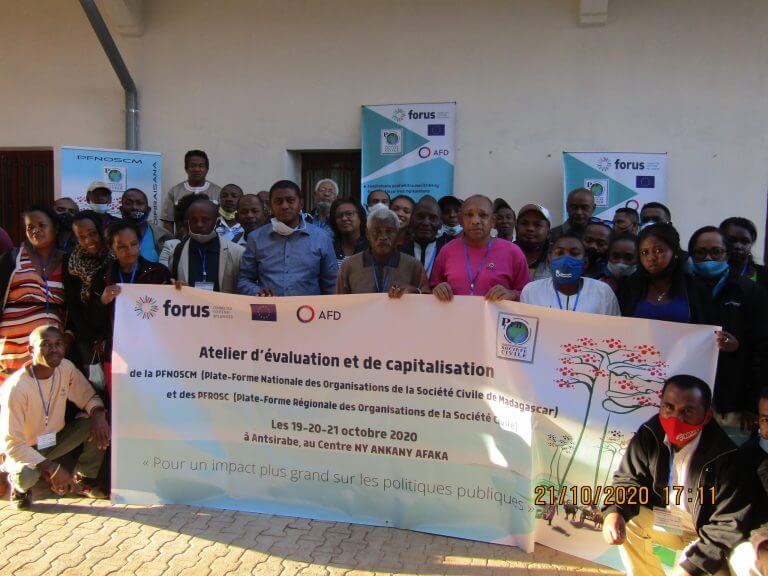
The first meeting organised by PFNOSCM with its subdivisions, funded by the European Union and AFD with support from Forus, from 19 to 21 October 2020 in Antsirabe, made it possible for the first time to convene technicians and resources staff from the Regional Platforms of Civil Society Organisations or PFROSCs around the same table to think about how to revitalise the organisation with a view to performing its duties. These duties have been undertaken poorly or not at all, in particular finding solutions to the many public interest issues.
Discussion over the three days focused on two key points: i) assessment of PFNOSCM and PFROSC in terms of organisational and institutional aspects, and ii) capitalising on experience and best practices.
The assessment concerned organisational aspects, consisting of a review of the vision and mission, the structure of the organisation, working relationships on a national level, at the level of each PFROSC and between national and regional levels, as well as the organisation's leadership on all levels, the decision-making system, circulation of information and the internal control system. As regards institutional aspects, discussion centred on the organisation's strengths, weaknesses, opportunities and threats or SWOT, in order to draw from them proposals for solutions to enhance opportunities that present themselves or control risks.
Capitalisation looked at two aspects: i) discussion and a review of the best practices of PFROSCs and civil society organisations at an already advanced stage in terms of awareness-raising and advocacy, and ii) a review of the approaches or means of organisation derived from experience that could improve methods of engagement.
At the end of this very technical workshop, participants were aware of the shortcomings. They also admitted that improvements need to be made so that PFNOSCM and PFROSCs are able to play their full role as civil society organisations in a country very rich in natural resources but with very poor people, and governance and civic space requiring major transformation. Patrick RAMAROSON, one of the participants from the South-West PFROSC, commented, "In general, civil society plays a very important role in the life of a country like Madagascar because it has a public interest role. The population and members of civil society hope that there will be a change in terms of governance, approaches and public policies in Madagascar."
The results of this review will be communicated to delegates of the 22 regions at the Third National Convention next December in order to make strategic decisions with a view to revitalising PFNOSCM.