Mon 31 Oct 2022
What do we talk about when we talk about the enabling environment?
Red Encuentro mobilises conversations around a controversial issue for CSOs in Latin America
by Julieta Villar, Head of Communications at Red Encuentro.
In the framework of the project that Red Encuentro is carrying out together with the Paraguayan network Pojoajú, with the support of Forus, activities aimed at dialogue and reflection will be carried out throughout 2022 focusing on the link between Civil Society and State, and an enabling environment for Civil Society Organisations in the region and worldwide.
Along these lines, in May, both networks organised the thematic workshop The Enabling Environment for CSOs, with the participation of Raúl Campos Domecq, member of the Executive Committee of the Pojoajú Network. It was a propitious space for the exchange of experiences on the realities lived by organisations in each country, with the similarities and differences that each context brings, and the challenges that lie ahead for the region, especially with regard to the co-construction - together with state bodies - of policies that contribute to guaranteeing rights.
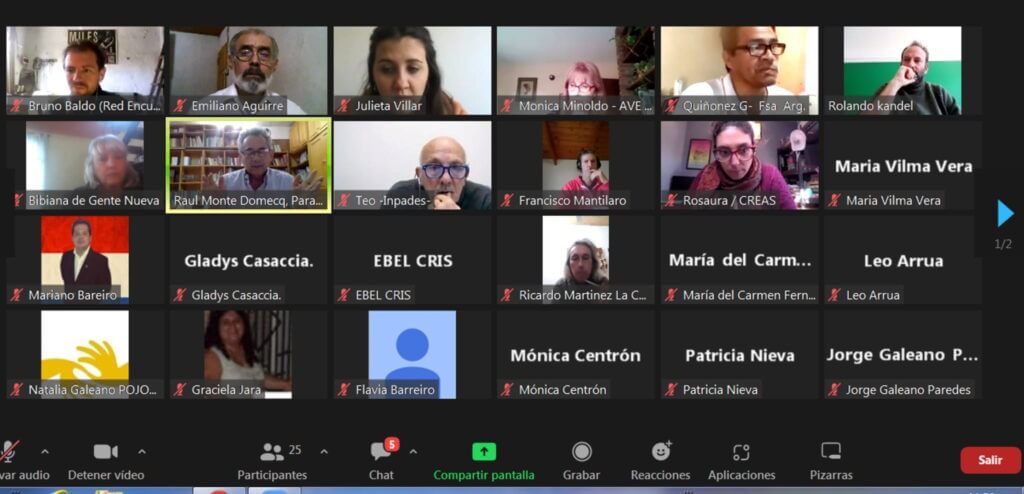
Under the title "How to prepare to generate favourable environments in our organisations", a virtual workshop-debate was held in July, organised by the Red Encuentro.
On this occasion, the activity was attended by two speakers: Alberto Croce, director of Articulation with Civil Society at the National Ministry of Education; and Néstor Borri, executive director of the Centro Nueva Tierra, who shared their presentations with members of organisations from numerous Argentinean provinces as well as Paraguayan brothers and sisters.
In this second activity, the theme of the enabling environment for organisations was contextualised in the reality of Latin America and Argentina. A warning that emerged in this regard had to do with the use of the issue to position itself against popular governments, thus leading to a "boycott" of attempts by weaker states to install more popular agendas.
The dialogue revolved around the need to reflect on the participation of organised citizens, and the challenges that such participation poses, particularly in Argentina.
Among the questions that arose, a central one was: "What participation do we as organisations enable ourselves, from within our organisations? Who can participate within our organisations, who do we listen to and who do we not listen to, who do we want to listen to and who do we not want to listen to?
On the other hand, the organisations' character as promoters and defenders of rights was highlighted, opening the game to new perspectives for the expansion of rights, based on a more diverse agenda, with new issues in the social debate related to the political question.
When the organisation itself becomes more of a concern than the cause being defended, warned Alberto Croce, "the organisation becomes a kiosk, with its own interests, its own needs". In this respect, he pointed out: "The causes belong to everyone, the kiosk belongs to the owners of the kiosk". When organisations approach the state with the idea of the kiosk, he added, "it is generating a privatisation mechanism".
In reference to the current situation in Argentina, the warning was about the moment of danger that humankind is experiencing and which is having an impact on the communities of each country. In view of this, there is a need for "thinking situated in time and space".
Another question on the table has to do with the "what for" of the promotion of an enabling environment. The warning that emerges is that enabling civil society can on the one hand "strengthen democracy" but also be a way of "dissolving communities".
For this reason, there is a risk of enabling social organisations, even those that promote rights, when they fail to promote social justice; and equally, promoting rights without wealth distribution.
"Enabling the citizenry may be limiting the mission of the state", warned Néstor Borri. In this sense, the call is to take on the challenges of ensuring that "an enabling environment does not favour the growth of social organisation as a commodity of micro-rights, organised only by the logic of difference" and to "avoid the risk that our grassroots organisations, especially the large ones, the popular movements, are not transformed into 'police' organisations, in the sense of containment, of control of the poor".
There are three areas that can strengthen organisations: "Providing citizenship, providing subjectivity, and providing emancipation". On this, he insisted, it is necessary to work, but "above all to ask ourselves again the question: what are we talking about; with whose words; in the name of what projects and what perspectives of rights, social justice, country and democracy".
The project plans to hold a bi-national meeting with the participation of organisations from across Latin America, and a survey of experiences of articulation with the state and the co-construction of public policies.