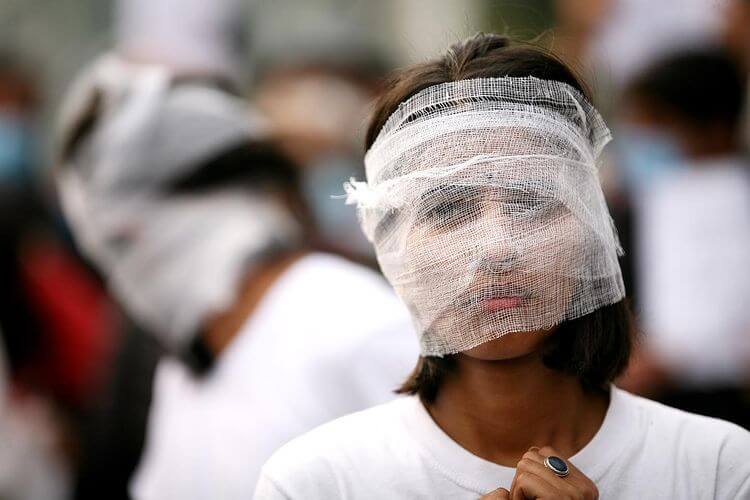
© Sanjog Manandhar
Mon 8 Dec 2025
Civil society under pressure – and rising together: A comparative look at enabling environments across Africa, Latin America & Europe
Across Africa and Latin America, civil society faces a rapidly shifting landscape. From shrinking enabling environments and restrictive NGO laws to rising digital surveillance, restricted and reduced funding, polarised narratives and new barriers to participation, the enabling environment is under strain. Yet across regions, civil society networks are organising, connecting and shaping political agendas in innovative ways.
Forus – together with partners in the EU System for an Enabling Environment for civil society (EU SEE), the CELAC-EU civil society working group, and the Africa-Europe Civil Society Platform (CSEP) – is helping turn this moment of democratic regression into an opportunity for collective advocacy, cross-regional solidarity and evidence-based dialogue. EU SEE data, which gathers verified early-warning reports from 86 countries, provides a common foundation for understanding how these trends are evolving and how civil society is responding.
This comparative article explores what these regional trends reveal, why they matter for global cooperation and how Forus contributes to strengthening civic resilience across the continents.
The enabling environment is tightening
Africa: A system under pressure
EU SEE data from 29 African countries shows a region in which fundamental freedoms are being tested:
- Peaceful protests face intimidation, excessive force, arrests and, in some countries, internet shutdowns — as seen in Kenya, where the Finance Bill demonstrations triggered violence, media blackouts and attacks against civic actors.
- New or revised association laws are rewritten without consultation, such as in Benin, where a draft CSO law was submitted behind closed doors, and in Botswana, where annual electronic re-registration risks mass deregistration
- Politically sensitive periods intensify repression: in Burundi, elections have been accompanied by arbitrary arrests and forced exile of HRDs and journalists; in Zimbabwe, watchdog meetings have been disrupted and student activists suspended.
- Compliance burdens and sudden funding cuts reshape who survives— particularly impacting grassroots and rights-based groups .
- Public narratives increasingly paint independent CSOs as “foreign agents”, like in contexts like Chad, Botswana and Zimbabwe, fueling mistrust and shrinking legitimacy
- Digital repression — surveillance, cybercrime laws, website blocking — restricts online organising.
- Participation spaces exist but often remain symbolic, with limited influence on final decisions.
These constraints are most acute around elections, constitutional reforms and anti-corruption activism.
But openings exist: Access to Information laws, Open Government Partnerships commitments, peace charters recognising CSOs, and court rulings that pushback against executive overreach.
Latin America & the Caribbean: democratic backsliding and new social coalitions
Latin America faces similar – though differently structured – pressures:
- Restrictive NGO laws (Peru’s APCI reform; Paraguay’s “Ley Garrote”; Honduras’ NGDO Law; Ecuador’s opaque regulatory practices; El Salvador’s Foreign Agents Law; Venezuela’s NGO oversight law).
- Criminalisation of defenders, journalists, and protesters— from preventive warnings against environmental leaders in Peru to attacks on journalists during protests in Bolivia, and heavy-handed responses to demonstrations in Panama.
- A growing funding crisis for grassroots actors, intensified by U.S. aid cuts across the region and stricter bureaucratic controls.
- Digital harassment, disinformation, and data exploitation.
- Polarised public narratives portraying civil society as partisan or foreign influenced.
Paraguay exemplifies the trend: a new NGO law (“Ley Garrote/Anti ONG”) restricts the rights to association and expands state control, while political actors publicly attack critical CSOs. Yet, public trust surveys show that NGOs remain among the most trusted institutions – higher than the legislature or judiciary.
Not all is decline. Panama’s courts defended press freedom; Panama’s courts defended press freedom; Chile advanced a structural reforms law on association and strengthened its digital rights framework; and Bolivia’s recent application of the Escazú Agreement set a promising precedent for environmental defender protections – reminders that civic resilience still shapes political outcomes.
Europe: a partner navigating tensions at home and abroad
While European states generally offer stronger protections, the region is not immune to:
- SLAPPS and lawfare against NGOs and journalists like in Georgia or Hungary.
- Digital surveillance debates
- Far-right narratives targeting civic actors, illustrated by expanding cybersecurity and data-access powers in parts of Central and Eastern Europe, and growing concern over the proportionality of such frameworks.
- Far-right narratives targeting civic actors.
- Funding pressures for watchdog organisations, as public financing models shift in countries like Poland and the Czech Republic, making independent scrutiny more precarious
European civil society increasingly recognises the importance of shared responsibility for an enabling environment — within Europe and in partner regions.
A shared vocabulary: “enabling environment” as the new global benchmark
A key insight from the EU SEE data is the need to shift from talking about “civic space” to addressing the broader “enabling environment”.
Civil society does not only need freedom from repression – it needs:
- Fair and transparent laws
- Stable access to resources
- Safe digital environments
- Constructive public narratives
- Effective participation mechanisms
- Predictive and inclusive policymaking
This holistic approach mirrors the six principles used across EU SEE reporting and is at the core of Forus’ work globally.
How Forus bridges regions: evidence, solidarity and collective advocacy
Through the EU SEE project
Forus, alongside 5 other organisations, plays a central role in generating, validating and communicating early warning on civic space data. EU SEE has shown that solidarity is a form of development cooperation:
- CSOs sound the alarm
- Relevant partners elevate these concerns in political dialogues
- Joint advocacy builds accountability
- Evidence informs AU-EU and EU–LAC agendas
When restrictive laws or funding freezes emerge in one region, partners in another mobilise support and bring these concerns into diplomatic conversations — showing how shared protection strengthens cooperation.
Through the CELAC–EU Civil Society Working Group (LAC–Europe)
Across regions, civil society continues to face shrinking space — yet it is rising together with renewed coordination and solidarity. A strong example comes from Latin America and Europe, where Forus played a central role in mobilising and uniting organisations ahead of the EU–LAC Summit. Working closely with the members of the LAC–EU Civil Society Forum Steering Group, Forus helped lead the drafting and consolidation of the civil society position, ultimately bringing together 190 organisations that endorsed the joint statement ahead of the official Summit. This collective effort not only strengthened the visibility and influence of civil society in the EU–LAC partnership but also demonstrated what is possible when diverse networks coordinate strategically across borders. It showed how regional alliances — when supported by global platforms like Forus — can amplify shared priorities, defend civic space, and present unified, coherent demands to policymakers in moments of political tension and democratic backsliding.
From regional diagnosis to bi-regional civic agendas
Beyond shared risks, 2025 also marked a consolidation of bi-regional civil society agendas that translate enabling environment concerns into concrete political asks.
At the AU–EU Civil Society and Youth Forum, African and European CSOs and youth organisations issued recommendations across peace, prosperity, people and multilateralism, with strong emphasis on inclusive governance, evidence-based decision-making, institutionalised civic participation, predictable and accessible funding (including for grassroots and youth-led actors), and protection of civic freedoms both offline and online. The declaration also explicitly highlights digital governance, cybersecurity, and responsible technology use as part of democratic resilience.
In parallel, the AU–EU Civil Society Parallel Summit Statement reinforced a structural critique of the partnership and called for a shift toward justice, inclusion and meaningful democratic participation. It emphasized protecting civic space and independent media, strengthening local governance, ensuring transparent and community-led natural resource governance, and advancing a joint African-European civic agenda ahead of major 2026 processes.
Similarly, the LAC–EU Civil Society Forum Declaration adopted in Santa Marta outlines a rights-based vision for the bi-regional partnership anchored in meaningful, inclusive and intergenerational participation. It calls for strengthened enabling environments for defenders and journalists, safeguards in trade and investment, direct and flexible financing for local CSOs, climate justice and territorial rights, and stronger accountability around Global Gateway and related initiatives. The declaration also highlights the Bi-regional Care Pact as a cornerstone for substantive gender equality and underscores that the digital transition must be grounded in democratic governance, inclusion and rights.
A shared direction across Africa, LAC and Europe
Read together, these two bi-regional declarations show a converging civic agenda across regions: participation with real influence, protection of fundamental freedoms, fair legal and funding frameworks, rights-based digital governance, and accountable investment models that put communities at the centre. This alignment reinforces the value of shifting from a narrow “civic space” lens to a broader enabling environment framework that can be operationalised in bi-regional cooperation.
How Forus can help carry these agendas forward
Forus’ added value is precisely in helping these member-driven agendas travel across regions and into policy processes — by connecting early warning evidence with joint advocacy, supporting cross-regional narrative coordination, and helping ensure that AU–EU and LAC–EU commitments translate into implementation standards, predictable resourcing and meaningful monitoring.
Opportunities for joint action in 2026
Building on the priorities articulated in both declarations, 2026 offers strong potential for shared advocacy on:
- Minimum standards for meaningful public participation in bi-regional cooperation.
- Safeguards for civic freedoms and independent media, including protection of defenders and journalists.
- Predictable, flexible and direct funding models that reach grassroots and youth-led organisations.
- Rights-based digital governance that limits surveillance and counters online harassment and disinformation.
- Binding human rights, environmental and participation clauses in major investment and trade frameworks.
In short: the regional trends point to mounting risks — but the bi-regional civil society forums demonstrate that civic actors are also building a shared political roadmap for resilience, accountability and democratic renewal.
A Shared Theory of Change Across Regions
Across Africa, Asia, North America, Europe and Latin America, Forus advances the same pillars:
- Protection: defending civic freedoms and digital rights
- Participation: making consultations meaningful, not symbolic
- Sustainability: ensuring predictable and flexible funding
- Narratives: countering delegitimisation through collective messaging
- Data: transforming alerts into advocacy and policy impact
- Solidarity: linking national struggles to regional and global agendas
This integrated model positions Forus as a connector between regions facing different challenges but sharing the same aspiration: an enabling environment where civil society can shape fairer, more sustainable development.
Opportunities for joint action in 2026
Based on cross-regional analysis, at least five areas offer strong potential:
- Common standards for public participation and consultation
- Joint advocacy on digital rights and surveillance safeguards
- Flexible, equitable funding models for grassroots organisations
- Narrative alliances to challenge delegitimising discourses and defend the enabling environment
Forus is uniquely positioned to convene actors across regions, translate local evidence into strategic advocacy, and help shape a global enabling environment agenda grounded in lived experience.
Conclusion: Civil Society Is Not a Side Actor — It Is a Pillar of Democracy
Across Africa, Latin America, and Europe, civil society is facing unprecedented pressure — but also demonstrating unprecedented resilience, creativity, and solidarity. At a time when democratic erosion feels overwhelming, Forus’ work demonstrates that civil society is still shaping global agendas — not from the margins, but from the centre.