© Forus



2025-11-14
In the next five years: Breaking the SDG Bubble
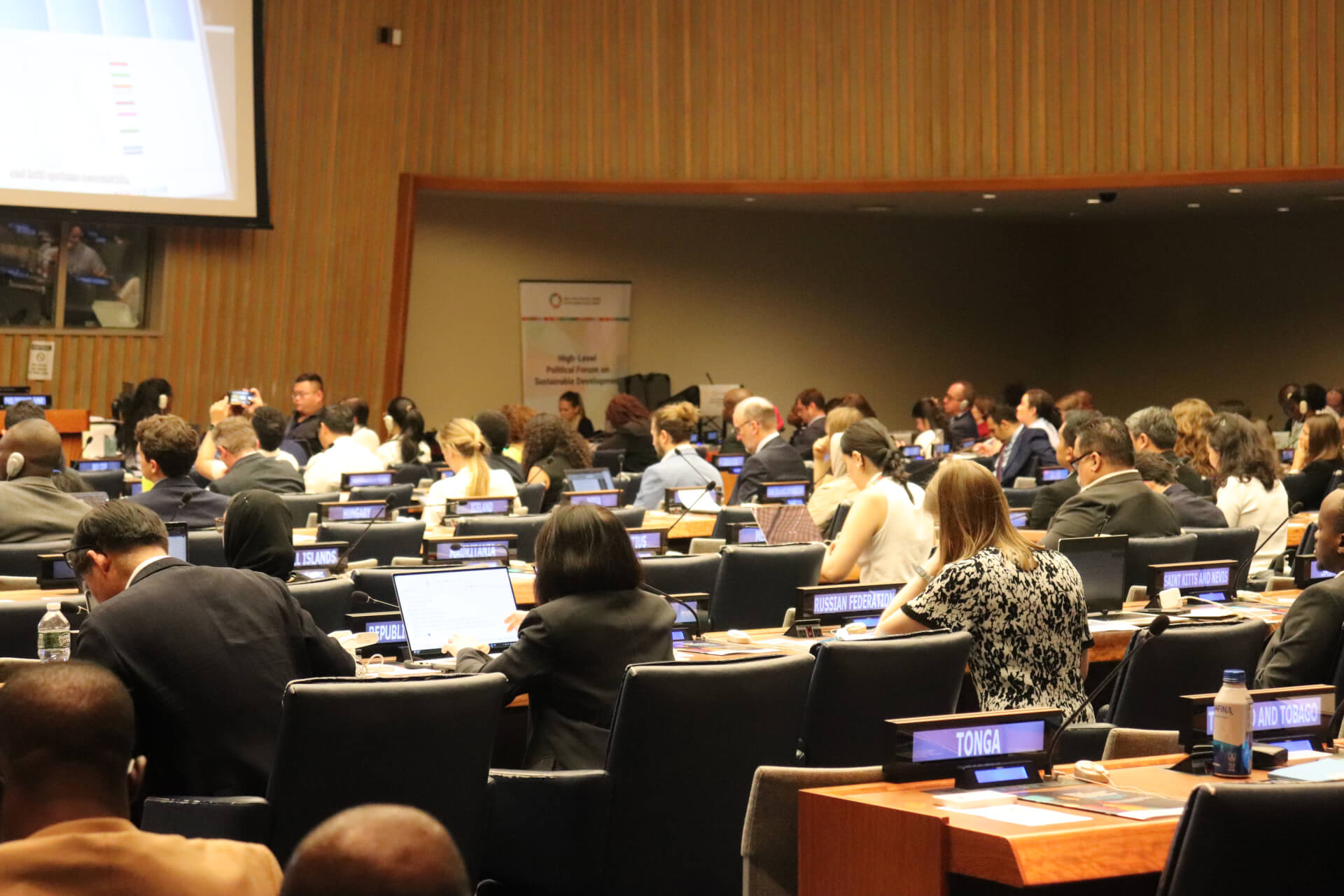
As the world marches the critical final stretch toward 2030, Forus members from across the globe are raising urgent concerns about the growing "invisibility" of the Sustainable Development Goals in political discourse shaped by shifting geopolitical dynamics and shrinking civic space - and questioning whether this issue represents not mere oversight, but deliberate opposition. At the same time, they emphasised the need to counter this retreat by strengthening civil society coalitions, amplifying evidence-based advocacy, and pushing for renewed political will to keep the SDGs visible and actionable.
A Critical Juncture
Out of the 37 member states scheduled to present Voluntary National Reviews (VNRs) in 2026, Honduras has withdrawn, leaving 36 countries reporting next year—an indication of growing concerns about the diminishing visibility of the SDGs among member states.
“This is the final push period for SDG achievement,” one participant stressed. “Governments cannot simply highlight successes; they must acknowledge setbacks. Instead, SDGs are increasingly being treated as optional.”
Recent developments illustrate the trend: Japan’s newly appointed prime minister made no mention of the SDGs, the environment, or climate change in his inaugural parliamentary speech, while proposing renewed oil subsidies. Bolivia’s new president likewise omitted Agenda 2030 in his inaugural address. Argentina’s withdrawal from its 2024 VNR further signaled declining political commitment to SDG reporting.
From Fatigue to Opposition: A Global Pattern
What emerges from Forus members’ testimonies is a two-fold crisis: growing “SDG fatigue” in some countries and political instability eroding commitment in others—both increasingly reinforced by deeper ideological opposition to the agenda.
"We're experiencing what they call SDG fatigue. Our stakeholder roundtable should meet three times annually with five ministers, but it only met once in the last two years," says Aron Halfen from the Norwegian Forum for Development and Environment.
Norway’s former prime minister, who was one of the co-creators of the foundational "Our Common Future" report (commonly known as the Brundtland Report) that developed the sustainable development concept, is now struggling to maintain momentum. "The private sector is moving away from 'sustainability' language and leaning more towards 'investments and strategies,'" Halfen noted. "We need stronger mobilisation to accelerate this agenda."
In Japan, despite over 90% public awareness of SDGs, a disconnect exists between knowledge and action, which has become glaring. "Most people are aware about SDGs, but they're not actually involved in mobilisation for changing policies," explained Aoi Horiuchi from the Japan NGO Center for International Cooperation (JANIC). "The government treats SDGs as international issues rather than domestic ones. Parliament shows minimal interest; there's no SDG-specific legislation being discussed."
For countries facing political transitions, the challenges are equally corrosive to SDG progress.
Iris Baptista from UNITAS, Bolivia, shared the frustration felt by many civil society organisations across the globe: "It seems that only NGOs are trying to focus on this movement and create awareness. I believe each time we are further away from the goals. This is not part of the political agenda."
From Honduras, Jose Ramon Avila of ASONOG painted a picture of compounding crises: "Over 50% of our population lives in poverty. We face growing inequality, corruption, violence, climate impacts. And now, approaching elections, we see government interest in SDGs declining. When governments change, all officials change. Policy continuity becomes impossible." The results are clear, as the government of Honduras withdrew from presenting its VNR in 2026.
In Mozambique, Simao Tila from JOINT LIGA DE ONGs described serious circumstances including post-election violence and mistrust in institutions. “We face high levels of corruption and constant leadership changes. We may not always achieve everything we aim for, but even reaching 60–70% is progress,” he said.
Is the invisibility intentional?
A question posed by the Asociación Chilena de ONG - Forus member from Chile, Miguel Santibañez: "Is this invisibility of the SDGs just not mentioning them in discourse, or is there a bigger problem with the Agenda 2030, a kind of criminalisation in a political context different from 2015?"
The question resonated because it mentions what most of the civil society organisations have been thinking: that SDG "invisibility" may represent not fatigue or competing priorities, but active opposition framed as a "cultural battle" against perceived "globalist agendas."
José Ramón Ávila highlighted a troubling pattern across Latin America: governments often refer to SDG commitments in speeches but rarely follow through in practice. "There's major incoherence with a gap between what is said and what is done. And this is intentionally oriented by agendas of governments, particularly the U.S., having policies contrary to rights."
Alternative Spaces, Persistent Hope
Carlos Arana, from ANC Peru, suggested a pragmatic approach forward: "When national governments are resistant, we need to find spaces beyond them by engaging with academia and some business sectors, but especially local and regional governments. They can understand needs more clearly as they are more permeable to receiving messages. They're better positioned to work in their territories."
Different regions have developed different strategies for maintaining pressure. Japan has institutionalised civil society participation through an SDG Roundtable with guaranteed seats and public comment periods on VNR drafts. Norway integrates civil society input directly into official government reports, with each SDG target receiving a page of civil society assessment.
Mozambique uses "observatories," platforms where civil society meets regularly with government and development partners to evaluate progress. Honduras focuses on influencing inter-institutional commissions while building resilience amid multiple crises.
Insights shared by CNONGD - Conseil National des ONGD de Développement (Forus member in the DRC) highlight how civil society in DRC is actively organising to counter SDG invisibility by preparing for the country’s 2026 Voluntary National Review (VNR) by following structured, evidence-based and community-rooted approaches. CNONGD has also established an internal coordination mechanism for the VNR, launched preparations for a civil society alternative report, and strengthened its monitoring work through the Citizen Observatory for Peace, Governance and Economy (OPGE).
CNONGD’s newly adopted 2025–2027 Advocacy Plan and 2026 Annual Plan emphasise digital governance, protection of civic space, sustainable and accountable management of natural resources, gender equality, peacebuilding, and strong local participation. These forward-looking strategies demonstrate how national civil society platforms can resist the shrinking visibility of the SDGs by building collective capacities, producing data-driven analysis, and embedding Agenda 2030 within locally grounded development priorities.
The Pacific Voice: Development Must Nourish Its Roots
From the Pacific Islands, Akmal Ali, representing the Pacific Islands Association of Non-Governmental Organisations - PIANGO, emphasised the need for development approaches that honor community leadership and Indigenous knowledge: "You cannot ask the tree to bear fruit if you starve its roots. For development to succeed, it must nourish the systems closest to the people."
Kiribati will present its VNR in 2026 alongside Tonga and the Marshall Islands. Akmal stressed that meaningful participation depends on resources that often don't reach local communities: "The Pacific people have been fighting an unending struggles against climate change, which requires significant investment from the global community."
His vision for VNRs challenged the technical, government-centered approach that has often influenced the process: "We want VNRs that are not just government-owned, but nationally owned, co-created by everyone whose life is shaped by the development journey. What we ask today is that innovation be rooted in local knowledge and community values. Fly-in, fly-out solutions do not last. Pacific-led research, domestic industries, and Indigenous design must be front and centre.
He stresses, our ancestors taught us that the vaka, waka, walap - the canoe - must be strong at its centre. The people are our centre. Let us honour them by building VNRs that are not only technically sound, but deeply human.
Breaking the bubble
A recurring theme throughout the discussion was the need for civil society itself to lead the transformation. As Aoi Horiuchi of Janic puts it: "We need to break the cycle, we need to break the bubbles. We need to get out of our comfort zone in order to witness and experience real change."
Multiple speakers acknowledged the risk of operating in echo chambers, the same people attending the same meetings, speaking the same language, while broader publics remain disengaged. High awareness without mobilisation, achieves little while mobilising communities without government partnership, struggles to achieve systemic change.
The challenge is finding ways to simultaneously:
- Engage broader publics beyond the "usual suspects"
- Maintain pressure on resistant national governments
- Build alternative partnerships with local governments, academia, and progressive business
- Ensure financing reaches community-level actors who drive real change
- Shift narratives from SDGs as "international obligations" to frameworks for national development and human rights
What 2026 Must Deliver
As 36 countries prepare to present VNRs in 2026, including 14 Forus member countries, expectations are high that these reports will represent honest accountability rather than public relations exercises.
Norway's Aron Halfen acknowledged this uncertainty: "We need real-time campaigns to re-interest people in the Agenda 2030 of the SDGs. This is challenging both nationally and internationally to keep focusing on this and do as much as we can now towards 2030 by strengthening and forging the existing and new partnerships."
One innovative framing came from Norway's focus on "spillover effects" with the recognition that countries must examine how their policies have undermined other nations' SDG achievement, not just report on domestic progress.
This framing challenges the implicit nationalism in VNR processes and asks, "How can we achieve sustainable development globally when the consumption and production patterns of wealthy nations actively undermine progress elsewhere?"
There is a clear message to the international community: The final five years to 2030 represent not just a deadline, but a test of whether the multilateral cooperation and shared responsibility