2023-04-04
Promising Approaches To Disease And Emergency Preparedness, Surveillance And Response In Central Africa

By Danielle NLATE, Rigo GENE, Olivier INDOUMA, Jacques NGARASSAN (respectively, President of the National Platforms of Cameroon, DRC, Gabon and Chad)
Foreword
Every year, the countries of the Central African sub-region fall victim to conflicts, epidemics and natural disasters which continue to have a strong impact on living conditions, on the high level of poverty among the population, on the poor public infrastructure and social services as well as on the dynamics of inter-community conflicts over natural and mining resources. These events result in the loss of human life and the destruction or weakening of people's livelihoods, thereby undermining their health, food and nutritional security. The frequency and increasingly complex nature of these crises requires a holistic approach that integrates actions to strengthen preparedness, prevention and mitigation of epidemics through effective and timely responses and interventions that facilitate the transition to a condition of stability and development.
The unprecedented outbreaks of Ebola, monkey pox, Covid-19 and other emergencies such as natural disasters in Central Africa and the world show the importance of the active participation and involvement of all groups and organisations without exception. This means that the major challenge remains in the preparation, prevention and response to all health emergencies in Central Africa.
REPONGAC, the network of national NGO platforms in Central Africa, aware of the difficulties posed by these endemic diseases, has been organising awareness, response and alert campaigns against covid 19, cholera, Ebola haemorrhagic fever and monkey pox. Despite the lack of resources, we aim to set up focal points, an integrated system of surveillance, early warning, data collection, behaviour change and response to the various endemic diseases, events or natural disasters of international concern in the countries of Central Africa.
Summary
REPONGAC, the network of national NGO platforms in Central Africa, aware of the difficulties posed by these endemic diseases, has been organising awareness, response and alert campaigns against covid 19, cholera, Ebola haemorrhagic fever and monkey pox in partnership with its member national platforms. Despite the lack of financial resources, REPONGAC intends to set up focal points, an integrated system of surveillance, early warning, data collection, behavioural change and response to various endemic diseases, events or natural disasters of international concern in Central African countries.
The progress made in the implementation of these awareness campaigns in the cities and provinces of Cameroon, DR Congo, Republic of Congo and Gabon has been beneficial and REPONGAC is seeking to scale up these campaigns in all countries of the sub-region. Go beyond simple participation to engage religious leaders (Imam, Pastors, Priests), educational leaders (Heads of schools), traditional leaders (Head of neighbourhood) in the fight against these diseases. Mastering communication techniques to change people's perception, attitudes and practices on diseases and other events. Knowledge of the role of peer trainers or community focal points goes beyond simple awareness raising to include data collection, surveillance and permanent alert for an effective and sustainable response.
Introduction
The Covid-19 pandemic is a major health crisis caused by an emerging infectious disease that emerged in late 2019 in mainland China. The rapid and drastic measures taken by several African governments to contain the disease are having serious economic consequences. Regional forecasts currently indicate a 3-5% decline in per capita gross domestic product growth. It is estimated that a 3% decline in GDP per capita will push 13 million Africans below the international poverty line as a result of the disease. There are families and individuals in situations that are irreducible to the evolution of economic magnitudes. There are also fears of increased maternal and child mortality from preventable but untreated diseases due to the Coronavirus, a massive setback that jeopardises years of progress in improving human capital in sub-Saharan Africa.
Due to rumours about the non-existence of the disease and the validity of the vaccines in some Central African countries, there has been a neglect of the respect of the barrier rules hence the need to organise awareness and fight against the spread of the disease in the cities of Brazzaville in the Republic of Congo, in the provinces of Central KONGO and KWILU in the Democratic Republic of Congo.
Context and rationale
Since the beginning of the epidemic declared on 10 March 2020, the cumulative number of cases in the Republic of Congo and the Democratic Republic of Congo has shown that no country has been spared by this deadly pandemic. In the DRC, for example, there were 86,921 cases, of which 86,919 were confirmed and 2 were probable, 63,044 people were cured and 1337 were diagnosed. 044 people have been cured and 1337 have died. In the Republic of Congo, since the first case, a cumulative number of 8625 confirmed cases out of 97209 people tested has been noted, i.e. a positivity rate of 8.87%. According to the sitrep n° 131 of 17 February 2021, in the period from 10 to 16 February 2021, 3247 people were tested in five (5) departments (Brazzaville, Pointe-Noire, Bouenza, Likouala and Pool), 206 results were positive, i.e. a positivity rate of 6.34%; Brazzaville remains the largest outbreak with a positivity rate of 8.48%, followed by Pointe-Noire (3.04%); the average age of the cases is 40.36.
The registration of new cases (with a total of 28 confirmed cases in DRC) shows that the disease is not over; the fight against the response should continue; continue to sensitise the population to respect protective measures and to take vaccines.
The easing of these measures by the authorities does not mean the end of the disease. Despite the fact that the covid-19 test is free of charge, except for travellers, and is payable at 30 US dollars, there has been no rush among the population to be tested.
Among the cities and provinces affected are Brazzaville, Kinshasa, which recorded 46,692 cases, Central Kongo with 5,633 cases and Kwilu with 215 cases. With regard to vaccination, since the start of the vaccination operation in the DRC on 19 April 2021, 879,122 (1.63%) people have been vaccinated in relation to the target, namely 53,984,184 people to be vaccinated. The target is to reach 2.5 million people per month or 625,000 people per week. Although we do not have data for the Republic of Congo, we believe the situation is similar.
General objective of our campaigns
To contribute to capacity building on risk communication and community engagement as part of the response to the pandemic and other events and disasters in Central Africa.
Specific objectives
- To strengthen the communication capacities of community actors through the implementation of awareness raising activities in the communities.
- To sensitise more people in schools and churches in order to improve their knowledge and reduce the transmission of Covid-19, monkey pox, cholera, Ebola and other diseases.
- To provide the beneficiary population with prevention kits and protective materials to promote good practices.
The methodology
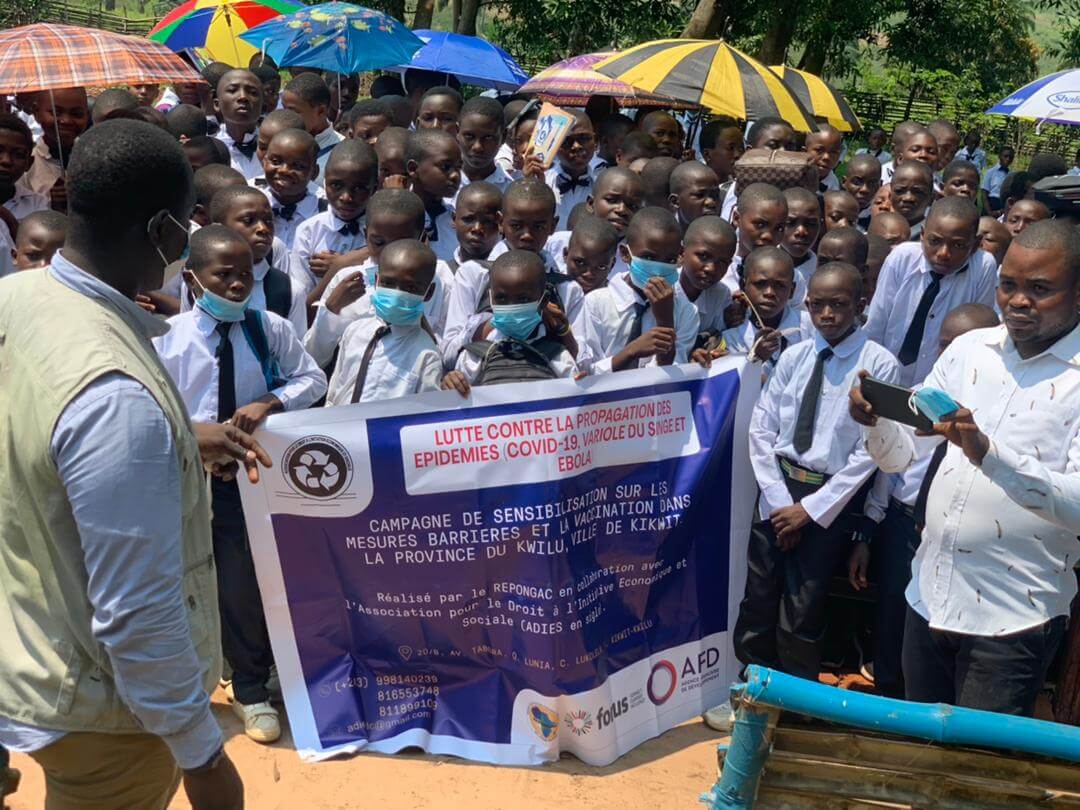
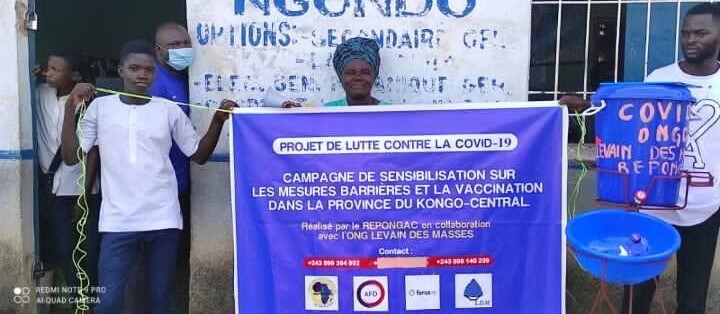
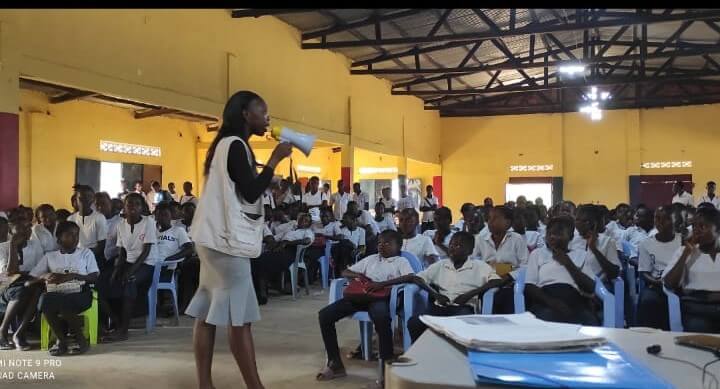
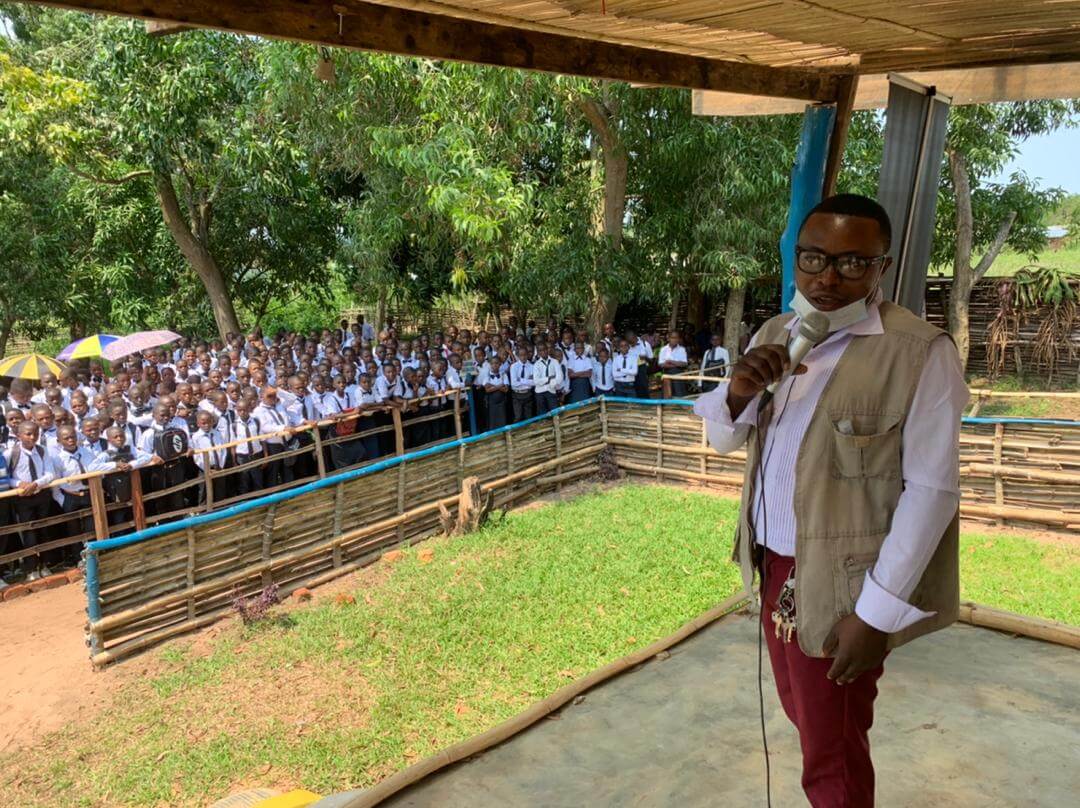
We began by training sensitisers chosen from among mass educators: school heads, church pastors and community and village leaders, who acted as focal points, monitoring activities, collecting data and helping to organise and lead Information, Education and Communication activities during the campaigns. The model used was adapted according to needs, taking into account time, strategic locations and people.
Data collection
We used all these means for data collection, including attendance lists at the activities and also call registers from the target schools. There were invitations issued and at the church level, the protocol sub-committees kept statistics on attendance at worship services. At the school level, attendance registers were kept by the class teachers.
Results achieved and deliverables
Awareness and response campaigns were carried out in Congo in Brazzaville and in DR Congo in the provinces of Central Kongo and KWILU in schools and churches and reached a total of more than 6000 people.
Training of Animators in COVID-19 prevention techniques
From the DRC in the provinces of Central KONGO and KWILU, and in CONGO Brazzaville there were 30 sensitizers trained in prevention techniques against Covid-19, monkey pox, cholera, Ebola and natural disasters.
As in any work or project, there is monitoring and evaluation to enable its evolution. The REPONGAC Regional Coordination, the Executive Secretariats of the national platforms and the focal points are involved in monitoring and evaluation to conclude whether or not the work should continue. The activities implemented are those related to the current context in Central Africa.
Conclusion
The unprecedented outbreaks of Ebola, monkey pox, Covid-19, natural disasters, inter-community conflicts over natural and mining resources, etc. in Central Africa show the importance of the active participation and involvement of all, community groups, civil society, public authorities, etc. These disasters continue to have a strong impact on living conditions, on the high level of poverty among the population and on the poor public infrastructure and social services. This means that the major challenge remains the preparation, prevention and response to all health emergencies in Central Africa.
Of course, it is no longer necessary to demonstrate the existence of epidemics that plague Central Africa in general and the DRC, Congo in particular, the most recurrent of which are Covid-19, monkey pox and Ebola. The awareness campaign carried out by REPONGAC with the financial support of AFD and FORUS has enabled the population to become aware of the different causes of the diseases, the modes of contamination and the preventive measures to limit the risks of propagation. It also stimulated the number of people vaccinated against COVID-19. The enthusiasm with which we were received everywhere we went enabled us to go beyond the expected results. Such campaigns have the merit of continuing in order to stimulate and awaken the population's awareness of the various present and future diseases with a view to putting in place control measures and reducing the risks of contamination and/or propagation.