© NGO Forum on ABD
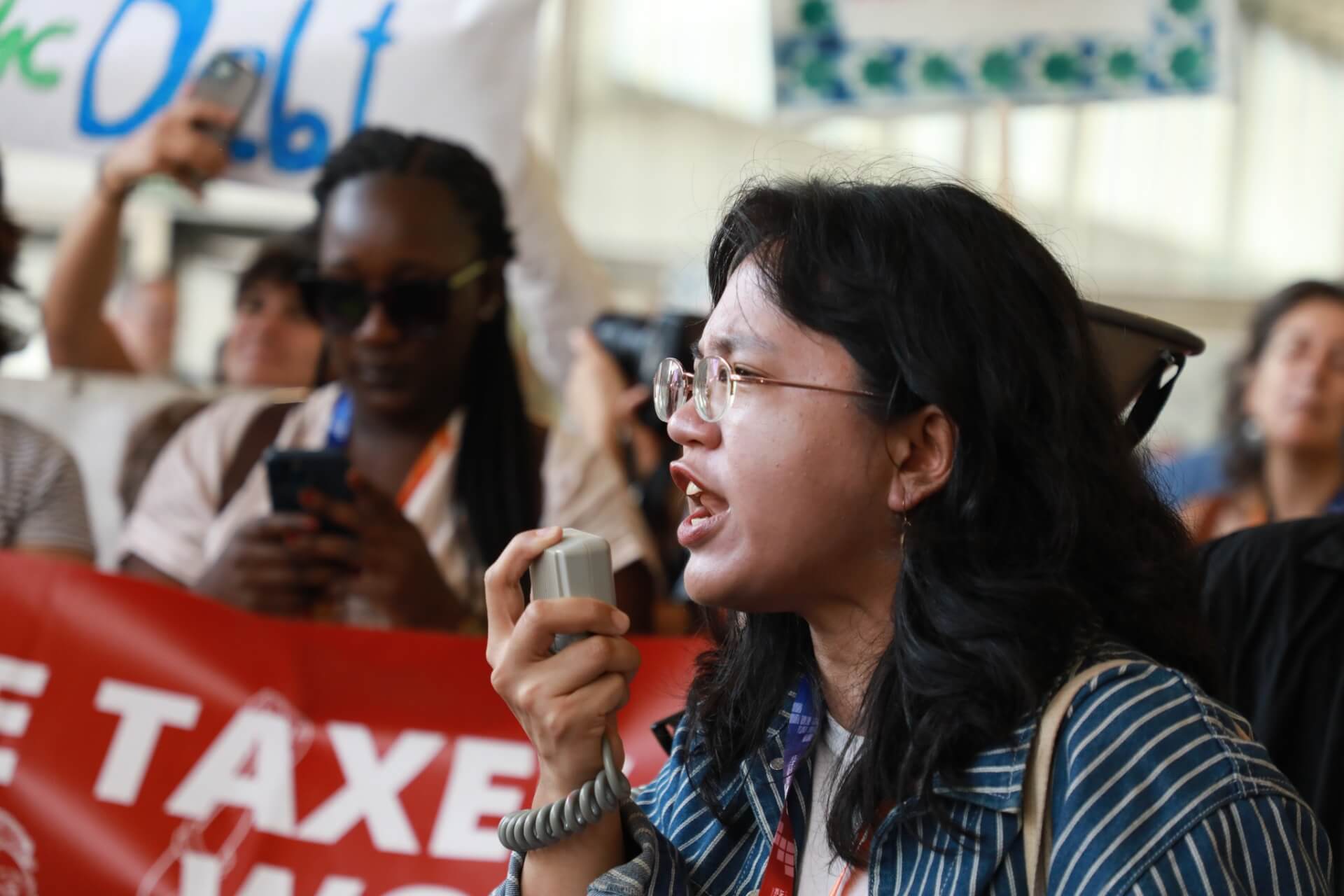
© Both Nomads/Forus
 MESA - Mesa de Articulación de Asociaciones Nacionales y Redes de ONGs de América Latina y el Caribe
2025-07-04
Standing firm in the storm: the indispensable role of civil society in a challenging global environment
By Susana Eróstegui Executive Director of the Bolivian Network for International Cooperation, on behalf of the Coordinating Committee of National NGO Associations and Regional Platforms of Latin America and the Caribbean (MESA)
Brussels, June 2025
At a time of multiple global crises—with growing inequalities, democratic setbacks and geopolitical tensions—I had the honour of participating in the European Union's Policy Forum on Development (PFD) on behalf of the Coordinating Committee of National NGO Associations and Regional Platforms in Latin America and the Caribbean (MESA). My interventions focused on the urgent need to ensure an enabling environment for civil society organisations (CSOs), particularly in a context marked by institutional fragility, the rise of populism and declining resources for development.
An alarming picture: civic space under threat
Only 3.5% of the world's population lives in countries where freedom of expression and assembly are fully guaranteed, according to the CIVICUS Monitor. The rest—more than 7 billion people—live in contexts where civic space is restricted, repressed or closed. This reality not only hinders our work: it poses a direct threat to democracy, human rights and the fulfilment of the 2030 Agenda.
Since Busan (2011), where CSOs achieved formal recognition as development actors in their own right, the commitments made to create an enabling environment have, in many cases, been neglected. Today, we could say that we are worse off than before.
How do we resist in such an unequal environment?
States have political power, the legal apparatus and institutional control. Donors control resources and strategic priorities. CSOs, on the other hand, have only our convictions, our causes and the legitimacy that comes from acting independently, transparently, with commitment and ethics. And that, although it may seem little, is an enormous strength.
In the face of restrictions, repression and narratives that seek to silence or divide us, we must continue to resist, propose and demand. And we must do so through democratic dialogue, with strategic allies such as the European Union, which has the possibility—and the responsibility—to defend civic space and promote policies consistent with the values it proclaims.
The environment we face is increasingly complex. CSOs are targets of attacks, co-optation, fragmentation and clientelism. Political polarisation, the use of technologies for social control, and media outlets subordinate to power erode our capacity for advocacy. And all this is happening while we face a progressive reduction in available funds and effective international support.
Populism, authoritarianism and loss of institutionality
It is no longer a question of left-wing or right-wing governments. In many countries in our region and around the world, what predominates is the desire for power at any cost. Judicial independence is being weakened, institutions are being instrumentalised, and all critical voices, especially those of social organisations, are being criminalised. Class, gender and ethnic divisions are being exacerbated, and the sense of the public good is being dismantled.
In this context, restoring ethics to politics is not an option: it is an urgent necessity. States must return to their role as guarantors of rights, rather than becoming their main violators.
Collective action for structural change
Faced with the magnitude of the challenges—poverty, forced migration, violence, extractivism, drug trafficking, human trafficking—CSOs must recover our capacity for collective action and overcome the lethargy imposed by bureaucracy. We cannot move forward without real political commitment, a willingness to build the common good, and a renewed outrage at injustice.
We also need to strengthen our self-regulation and accountability mechanisms, not only to gain legitimacy, but also to have moral authority when demanding the same from states and private actors. Public, clear and voluntary accountability strengthens our credibility and opens up spaces for stronger advocacy.
Reimagining cooperation and positioning counter-narratives
The current model of international cooperation, based on geopolitical and commercial interests, must be transformed. Increasing financial flows is not enough. An ethical and political reconfiguration of the relationships between donors, governments and civil society is required.
We must build counter-narratives that reposition the political and transformative role of CSOs. Narratives that denounce arbitrariness and abuse of power, that promote public debate and multi-stakeholder dialogue, that drive real and structural solutions for our peoples.
We must also:
- Consolidate alliances based on shared principles and values.
- Develop new capacities to diversify our sources of funding.
- Always put the common interest and solidarity before any political or commercial calculation.
Are we up to the task?
That is the question we must ask ourselves. Because if we continue down this path, few organisations will survive. Authoritarian governments will multiply and the poorest populations in the global South will continue to wait for answers that never come.
From civil society, we believe that we are up to the task—as long as we work in a coordinated and committed manner and with a clear vision of the change we want to build. Civil society is not an accessory actor. It is a fundamental pillar of democracy, sustainable development and the construction of a more just future for all people.