© NGO Forum on ABD



2026-08-03
System Update: A New Podcast Series Exploring Emerging Trends in Technology is Out!
From elections and public services to online platforms and access to information, digital technologies are reshaping our democracies, economies, collective and private existences at an unprecedented pace. Yet one critical question remains: who gets to shape the rules that govern these technologies?
To help answer that question and trigger new forms of collaboration, Forus is launching System Update, a new 12-episode podcast series produced as part of CADE – Civil Society Alliances for Digital Empowerment, a project co-funded by the European Union.
“System update” is usually a quiet background process a patch, a fix, an invisible improvement running in the background of devices we rely on. Yet through this series we see how there is no single update, no final version, no universally accepted patch. Instead, there are competing visions of what the system should be — and competing actors deciding what gets fixed, what gets ignored, and what gets permanently embedded.
This podcast series, episode after episode shows how digital governance is shaped by infrastructure and ideology, by regulation and resistance, by global frameworks and local realities.
Bringing together leading voices from civil society, technology, policy and academia, System Update explores how artificial intelligence, internet governance and digital rights are evolving, and why civil society must be at the centre of these conversations.
Throughout the series which is a journey from global governance discussions to regional experiences and local case studies, podcast guests share practical experiences, policy insights and advocacy strategies on some of the most pressing issues shaping our digital futures, including:
-
AI governance and democracy
-
AI ethics and accountability
-
Environmental and planetary justice
-
Internet governance and multistakeholder cooperation
-
Platform accountability and freedom of expression
-
Youth participation in digital policymaking
-
Accessibility and disability rights
-
Digital inclusion
-
Civil society advocacy in emerging technology governance
Guests include representatives from:
Over the coming weeks, you'll hear from:
🔹 Camila Weinmann & Daniela A. Rincón (Democracy Reporting International)
“We support AI governance mechanisms to ensure that AI teams prioritise their effects on human rights and not just security and safety.”
🔹 Asma Derja (Ethical AI Alliance)
“Right now harms in the Global South are almost invisible, invisible in every major data set. And that doesn't mean that the harms are not happening. It just means that they never make it to the global conversation.”
🔹 Sara Marcucci (AI + Planetary Justice Alliance (AIPJ))
“We really focus on what enables AI to be existing in the 1st place. And that means looking at, you know, from the very raw materials that are our mind for AI to be built all the way to disposal. And so we go from, you know, the whole supply chain and we look at every single stage of the supply chain and try to understand what are the planetary justice implications of those different stages. When we're talking about the AI supply chain, we're not really talking about anything, you know, singular. There's not one supply chain for AI. Of course, there's not one AI either.”
🔹 Mapalo Lukashi (BongoHive Technology and Innovation Hub)
“We have noticed that the current popular AI models that I use globally have a component that would love to call exclusion by design. And not that it's done intentionally, but by the very sense that a lot of Africa is not digitally visible, right?”
🔹 Rafik Dammak (ICANN)
“I think the challenge is really to try to avoid the hype and to discuss policy based on evidence, on research. And that's the thing what we are trying to push for. So we need to get better data and really to understand the risk based on research and not on what people perceive as possible risk.”
🔹 Diya Aravinthan (Better Internet for Kids)
“Young people don't just want to be consulted and used as a think piece, but they also want to be involved throughout the entire process. Youth are usually asked for small bits of feedback after major decisions in laws and other policies have already been made, when in reality, children and young people have such valuable insights from our everyday experiences alone.”
🔹 Agneris Sampieri (Access Now)
"Representation matters, and if you are only engaging with some sort of civil society representatives, like you are always inviting this person from the Global North, well, that's a problem, because an echo chamber is being created, and maybe the most vulnerable communities and people living risk situations are not in the Global North."
🔹 Nenden Sekar Arum (SafeNet)
“We know that digital platforms have their own community guidelines, their own policy statements but i believe transparency should go above these general public principles. Platforms should provide meaningful information about how recommendation systems work, about content moderation mechanisms, what factors influence visibility and how content ranking and moderation decisions are made.”
🔹 Dr. Muhammad Shabbir (IGF Dynamic Coalition on Accessibility and Disability)
"Nothing about us without us, as the famous saying goes in the disability community. We cannot claim this, nothing about us, if we do not come forward to speak for our own rights. So that's what motivates me to keep going. That if we do not speak for ourselves, we will allow others to speak and decide for us. That, for me, is unacceptable."
“Access matters, of course, but meaningful participation also requires safety, accountability, representation, and that real ability to influence the digital systems that increasingly shape public life.”
🔹 Malick Ndome (CONGAD)
“From the perspective of civil society, we say that internet connectivity is both a political issue and a social issue. Why? Because there are many barriers that need to be removed to make connectivity affordable and accessible for the population.”
🔹 Pedro Muiambo and Rita Morgado Leote (JOINT – League of NGOs in Mozambique and Plataforma Portuguesa das ONGD)
"We need a public registry of algorithms online for social auditing. Citizens need to audit — it cannot just be imposed."
System Update is produced by Forus as part of CADE – Civil Society Alliances for Digital Empowerment, a project co-funded by the European Union.
This podcast was co-funded by the European Union. Its contents are the sole responsibility of Forus and do not necessarily reflect the views of the European Union.
2026-07-27
Space for Us
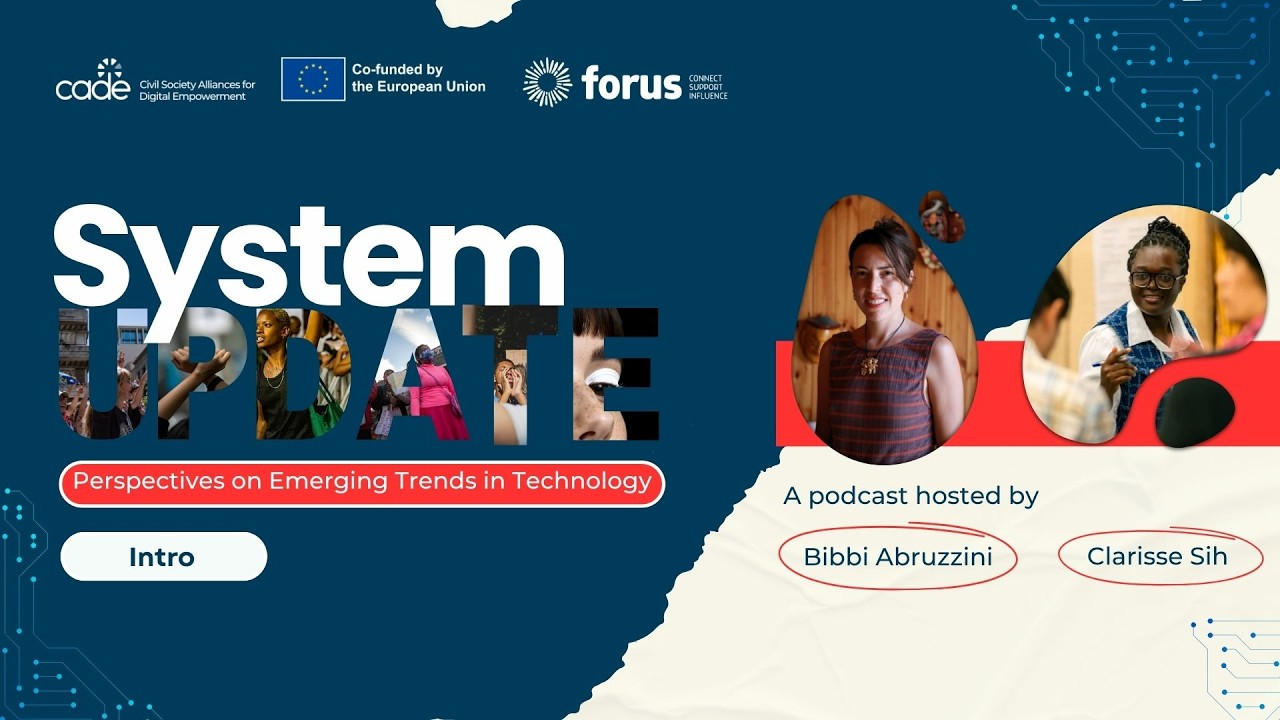
System Update - Introduction Are emerging trends in technology fast, inevitable, and neutral? No, there are complex political, social, environmental and intersectional dynamics behind them. They are constantly being shaped by decisions about power, governance, infrastructure, and access and these decisions in turn are already reshaping democracy, levels of inequality, and the ways we participate in public action and live our private lives. System Update is a podcast series brough to you by Forus as part of the Civil Society Alliances for Digital empowerment a programme co-funded by the European Union. Bibbi Abruzzini and Clarisse Sih from Forus are hosting this podcast, that follows the digital transformation across three interconnected levels: the global governance of emerging technologies in particular AI, its regional translation into policy and infrastructure, and its national and local impact on communities. The series moves from questions of regulation and rights to the realities of digital systems slowly tracing how digital governance is built, contested, and reimagined across the globe and in different regions. “System update” is usually a quiet background process a patch, a fix, an invisible improvement running in the background of devices we rely on. Yet through this series we see how there is no single update, no final version, no universally accepted patch. Instead, there are competing visions of what the system should be — and competing actors deciding what gets fixed, what gets ignored, and what gets permanently embedded. This podcast series, episode after episode shows how digital governance is shaped by infrastructure and ideology, by regulation and resistance, by global frameworks and local realities. And at every level, civil society emerges. Join us and be a part of the System Update! "System Update", is produced by Forus as part of CADE - the Civil Society Alliances for Digital Empowerment - a project co-funded by the European Union. CADE’s objective is to support the capacity of civil society organisations for effective advocacy in multilateral and multistakeholder internet governance processes. This podcast was co-funded by the European Union. Its contents are the sole responsibility of Forus and do not necessarily reflect the views of the European Union. Learn more about CADE: https://cadeproject.org/ Discover the Let's Talk Digital campaign: https://www.forus-international.org/en/campaign/let-s-talk-digital #CADE #D4D #Forus #digitalrights #ai #digitalgovernance #letstalkdigital
2026-07-07
Campaign
CADE Digital Rights Exchange Programme The Digital Rights Exchange Programme led by Forus and ECNL under the CADE initiative, invites three pairs of civil society organisations—bringing together one organisation from the Global North and one from the Global South —to collaborate in person for a focused, three-day exchange on a shared digital challenge and policy-advocacy strategy.
2025-09-05
Campaign
CADE Youth Voices for Digital Rights Our younger generations of digital natives are the first to have their entire lives encoded in digital data. As the biggest user group on social media platforms, and those feeling the consequences of emerging technologies the most, young people are deeply impacted by how the digital world is governed. Yet, their rights are often overlooked, and their perspectives are often missing from internet governance forums. That’s what we want to change.