© Forus



2026-03-08
The New Development Bank (NDB) at 10: Time to Build Meaningful Partnerships
By Marianne Buenaventura Goldman (Forus), Henrique Frota (Abong) and Harsh Jaitli (VANI)
|
As global development finance undergoes a period of rebalancing, the BRICS-led New Development Bank (NDB) has emerged as one of the most visible alternatives to institutions historically shaped by advanced economies. Established in 2015 by Brazil, Russia, India, China and South Africa, the Bank was designed to expand financing options for infrastructure and sustainable development across emerging market and developing countries. A decade on, as its membership broadens and its lending portfolio grows, the central question is no longer whether the NDB represents a shift in global governance — but how that shift is being institutionalized in practice.
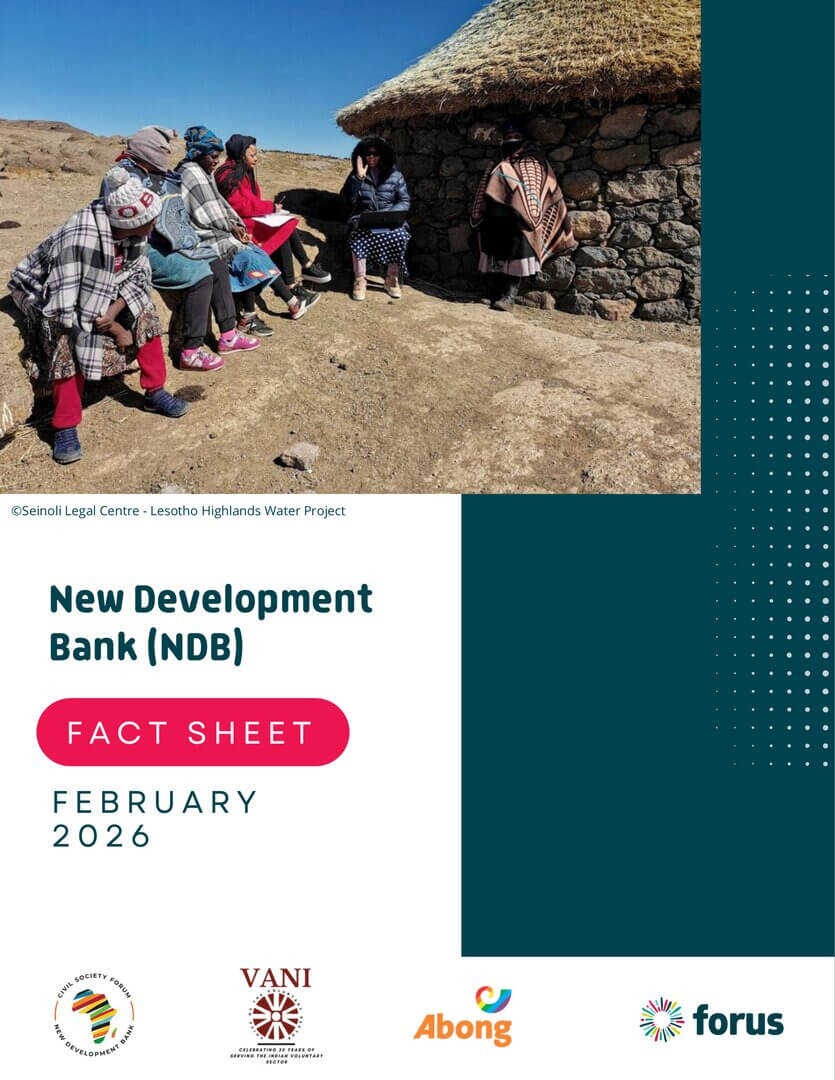
To ground this debate in evidence, Forus and civil society partners from BRICS countries launch the NDB Fact Sheet to unpack the NDB’s mandate, governance structure, expanding membership and project portfolio — separating institutional ambition from operational reality.
As the NDB expands beyond its founding members and deepens its global footprint, transparency, accountability, and meaningful civil society participation will determine whether it truly reshapes development finance — or simply redistributes influence within it. Establishing a formal civil society engagement mechanism, consistent with the standards of leading multilateral development banks would not only strengthen the NDB’s governance but also ensure that its operations reflect the perspectives and needs of the communities it seeks to serve.
|
When the New Development Bank (NDB) was launched a decade ago by the BRICS nations — Brazil, Russia, India, China, and South Africa — it was heralded as a fresh alternative to traditional financial institutions such as the World Bank and the IMF. Created to finance infrastructure and sustainable development projects in the Global South, the NDB promised a different model: one rooted in equality among members, local currency lending, and reduced dependence on the U.S. dollar.
Now, as the bank expands its membership to include Colombia and Uzbekistan, alongside Bangladesh, Egypt, the UAE, Algeria, and Uruguay, questions are resurfacing about what kind of development institution the NDB aims to become — and whether civil society voices will have a seat at the table.
A decade after its establishment, the NDB is entering its next five-year strategy (2027–2031). This is a defining moment for the Bank to establish a formal civil society engagement mechanism, addressing long-standing requests and strengthening the inclusiveness and credibility of its operations.
A bank built for the Global South
Since the NDB started its operations and opened its Shanghai headquarters in 2015, the NDB has approved more than $39 billion in financing, focusing on infrastructure, clean energy, water systems and digital development — and, as its President Dilma Rousseff has stated, positioning itself “to meet the challenges of the Fourth Industrial Revolution.”
The NDB presents itself as a development bank tailored to the priorities of its member countries. It supports projects aligned with national development strategies and works closely with borrowing countries’ institutions, emphasising respect for sovereignty and country ownership. A distinctive feature of its model is its commitment to lending in local currencies to reduce exposure to exchange rate volatility. During its first five-year strategy period, 23% of its loans were provided in local currency, and under its current 2022–2026 strategy, the Bank aims to increase this share to 30% of total financing commitments in member countries’ national currencies.
As the NDB grows in size and credibility, however, it also faces increasing scrutiny regarding transparency, accountability and inclusion — particularly in relation to its engagement with civil society organisations (CSOs).
A cautious approach to civil society engagement
The NDB’s approach to civil society engagement remains limited.
Despite efforts by civil society to engage with the NDB since its establishment, the NDB has yet to develop a formal framework for civil society participation comparable to those of other multi-lateral development banks as indicated in Forus’ Mapping Study on Public Development Banks Civil Society Mechanisms and Approaches. The NDB tends to prioritise government-to-government cooperation, leaving limited opportunities for CSOs to participate in project design processes or have a say in development of the banks policies.
For development banks, engaging with civil society must be about improving project quality and social legitimacy. CSOs play critical roles in ensuring environmental and social safeguards, reaching marginalised communities, and holding institutions accountable for their commitments to sustainable development.As the NDB expands its portfolio and geographic scope, particularly across Latin America, Africa, and Asia, it will encounter diverse civic ecosystems and governance contexts. Failing to create meaningful avenues for engagement could risk project backlash, reputational damage, and missed opportunities for collaboration.
From gender policies to environmental and social frameworks: gaps identified by civil society
CSOs have welcomed the NDB’s commitment to sustainable development but remain concerned about how its environmental, social and governance safeguards are implemented in practice. The NDB’s Environmental and Social Framework (2016) was designed to manage project risks and ensure meaningful consultation with affected communities. However, CSOs note persistent gaps between policy and practice, particularly the bank’s reliance on national systems that may lack adequate human rights protections, and the limited transparency around project documentation.
Examples such as the Lesotho Highlands Water Project have highlighted shortcomings in community engagement, compensation, and gender-based risk mitigation. Lessons-learned from other MDBs have shown the importance of developing a comprehensive gender strategy or policy to promote gender equality inclusive development.
Can a development bank truly deliver sustainable growth if it does not systematically address gender inequality? The answer is no. Infrastructure is not gender-neutral: projects that fail to consider gender dynamics — such as in the resettlement of local populations — risk leaving women behind, limiting their access to livelihoods, services, and decision-making. The consequences are especially felt in contexts such as Lesotho, where compensation is typically paid to male heads of household. An energy project that ignores household energy burdens overlooks who carries unpaid care work. A water system that fails to account for women’s time and safety reinforces inequality rather than reducing it. Development finance institutions that lack gender policies fund projects that ignore how inequality shapes outcomes. Such financing is not neutral — it is structurally incomplete.
Other key concerns are transparency and accountability. The NDB’s Information Disclosure Policy , often unable to obtain project documentation such as environmental and social impact assessments needed for independent monitoring. Moreover, the NDB’s absence of an operational Independent Accountability Mechanism (IAM) is also problematic. Although the bank has pledged that an IAM is close to being finalised and aligned with international standards, civil society groups have urged that the draft IAM be open to public consultation to ensure accessibility and independence. Clear recommendations by civil society have been submitted to the NDB on the need to enhance its practice of information disclosure and development an IAM. Finally, civil society is calling for the establishment of a dedicated gender policy in the bank’s next five-year strategy (2027–2032), arguing that such a framework is essential to align with global best practice and contribute to SDG 5 on gender equality.
Looking ahead
In an era where Global South institutions are redefining development leadership, the NDB has a rare opportunity to prove that sovereignty and accountability can advance together.
The NDB’s next General Strategy after 2026, expected to be released in the coming year, offers an opportunity to define how the NDB will lead. It is also an opportunity to develop a clearer and more proactive approach to civil society engagement.
As the NDB seeks to position itself as the premier development bank of the Global South, the question is not whether it can mobilise capital, but whether it can mobilise trust. Real partnerships with civil society could be the test that determines the difference between another lender and a truly new model of development finance.