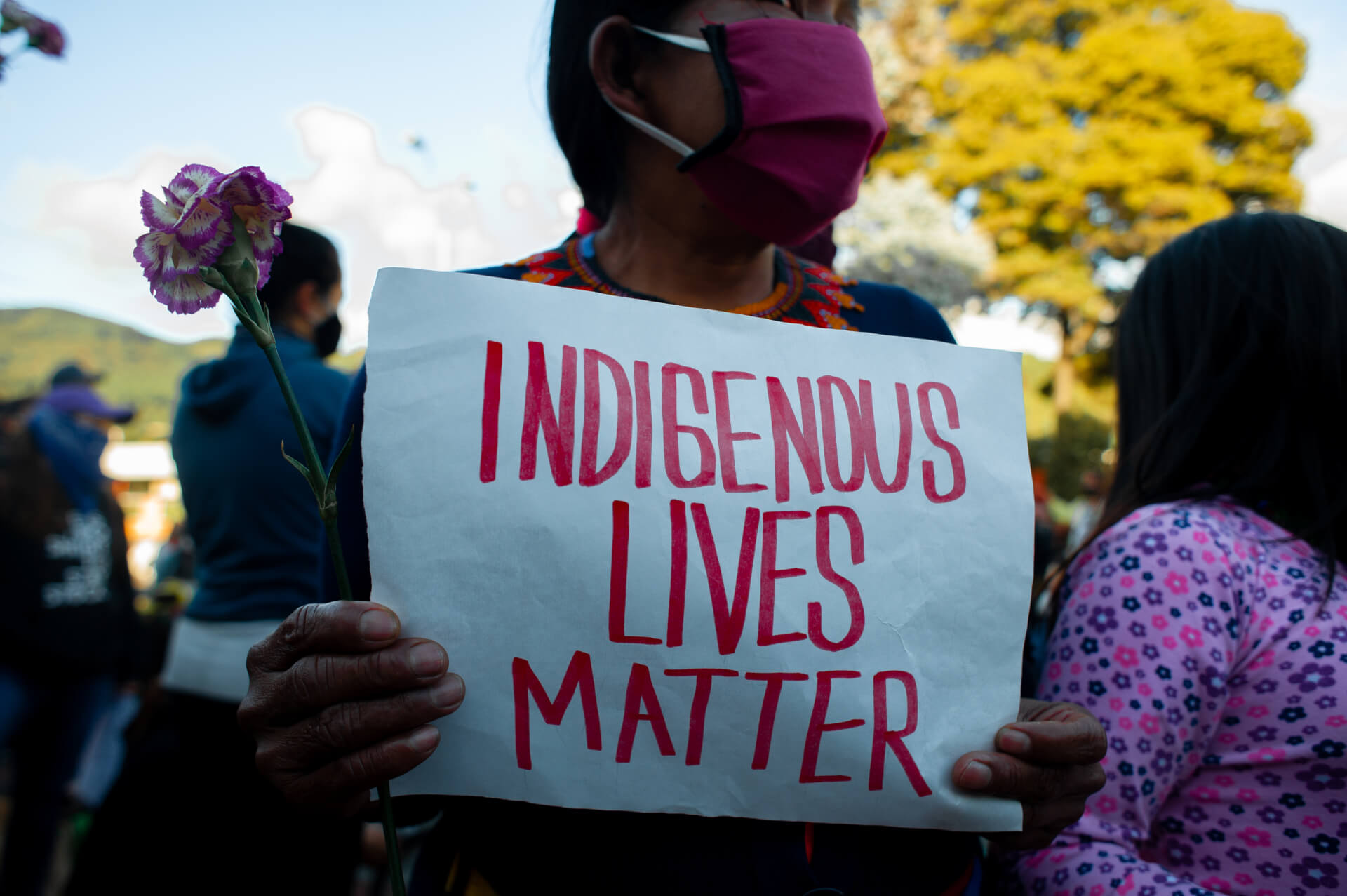
Indigenous People's activists in Colombia. © Sebastian Barros.
HLPF Report launch: "Sustainable Development by Shifting the Power: Capacity Strengthening of civil society as a key tool for the Implementation of SDG 17"
Monday 10 July 2023. Time: 07:30-09:30 NYC time / 11:30-13:30 UTC
Organizer: Forus
-
Date: Monday 10 July 2023
-
Time: 07:30-09:30 NYC time / 11:30-13:30 UTC
(Click here to see your local time) -
Simultaneous interpretation in English, French and Spanish will be available.
Join us for the launch of the report "Sustainable Development by Shifting the Power: Capacity Strengthening of Civil Society as a Key Tool for the Implementation of SDG 17." Developed collaboratively with 14 national and regional CSO platforms , this report provides an analysis of the transformative potential of capacity strengthening initiatives for civil society and a review of its representation in the 2022 Voluntary National Reports (VNRs). With a focus on changing power dynamics, ensuring localization, and decolonizing practices, the report underscores the pivotal role that civil society organizations can play in delivering the Sustainable Development Goals (SDGs) when appropriately supported.
Background:
The 2030 Agenda for Sustainable Development acknowledges the importance of capacity strengthening in achieving the SDGs, specifically highlighted in SDG 17 on Global Partnership and Means of Implementation.
However, research conducted by Forus based on the Voluntary National Reviews (VNRs) presented to the High-Level Political Forum on Sustainable Development (HLPF) reveals that there is room for improvement at UN Member States level, in terms of the approaches adopted and the funding of capacity strengthening for and with civil society.
The development of the report "Sustainable development by shifting the power: Capacity strengthening of civil society as a key tool for the Implementation of SDG 17" includes: a review of existing literature on CSO capacity strengthening, localization, decolonization, and power dynamics between the Global South and the Global North was conducted. Secondly, an analysis of the 2022 Voluntary National Reviews (VNRs) submitted by UN Member States to the High-Level Political Forum on Sustainable Development was carried out. Thirdly, inputs and advice were gathered from the Forus Advisory Group on SDG 17 & CSO capacity strengthening. Lastly, written accounts by national and regional CSO platforms provide concrete examples of and learning from CSO capacity strengthening initiatives and practices.
The launch event will gather civil society organizations, government representatives and UN institutions to underscore the importance of capacity strengthening in influencing public policies and reinforcing civic participation. Participants will discuss how transforming relationships, recognizing the value of local knowledge, and decolonizing practices can accelerate progress towards the achievement of the SDGs.
Objectives:
-
Present the findings and key messages of the report, emphasizing the importance of capacity strengthening for CSOs in promoting sustainable development.
-
Highlight the crucial need to value local knowledge and to shift the power in international development relationships.
-
Share regional and national case studies on CSO capacity strengthening.
-
Discuss recommendations and ways forward to support CSO capacity strengthening and foster inclusive practices.
Key questions:
-
How can capacity strengthening positively influence public policies and civic participation processes?
-
Why is continuous learning important for enhancing the impact of CSOs and their ability to advance the sustainable development agenda?
-
What has been the representation of capacity strengthening in Voluntary National Reviews (VNRs) since 2017? Particularly, has the public interest role of CSOs been recognized in promoting sustainable development?
-
Why is it crucial to transform relationships between Global South and Global North actors? How can we value local knowledge and engage in decolonizing our approaches towards genuinely inclusive practices in capacity strengthening?
-
What are the main funding challenges faced by CSOs, and why is sustainable funding important for their overall sustainability? What concrete suggestions have emerged to address these challenges?
-
How do regional and national approaches to CSO capacity strengthening vary?
-
What are the key recommendations for future efforts in CSO capacity strengthening?
RESSOURCES

2023-03-13
Using AI to ‘decolonise’ languageWe need to find a new language, new narratives, a new world view and the tools to create the words to overcome the “grand humanitarian narrative.” Can technology help?
2022-07-06
The capacity development of civil society is still not a priority for governments worldwideGovernments have failed to date to adopt a strategic, long-term and properly resourced approach to prioritize the capacity development of civil society, according to a new report by Forus, a global network of civil society organisations representing over 22,000 NGOs across the globe.
OTHER EVENTS