© Forus
(c)Tina Hartung

Mon 2 Mar 2026
Four Years: We stand because we stand together
Year One: When the Sirens Began
On the first morning of the full-scale invasion, the sirens did not just split the sky above Kyiv — they split time itself. There was a “before,” and then there was everything that followed.
In apartment courtyards in Kyiv, neighbors who had barely exchanged greetings before began weaving camouflage nets together. University students turned their lecture halls into supply depots. In Lviv, railway platforms became lifelines, crowded with mothers, children, and volunteers pressing sandwiches into trembling hands.
The state mobilized, yes — but so did society.
Civil society organizations that once focused on anti-corruption reforms, digital governance, or cultural heritage adjusted to the new reality overnight. Lawyers drafted emergency legislations by flashlight. Tech workers fortified servers. Journalists documented war crimes in real time. Grandmothers collected jars for homemade pickles destined for soldiers at the front.
The phrase passed from phone to phone, from shelters to checkpoints:
We stand because we stand together.
Year Two: The Architecture of Care
By the second year, shock had hardened into structure.
Grassroots initiatives became institutions. Telegram chats became registered charities. Crowdfunding campaigns bought ambulances, drones, tourniquets, winter uniforms. Psychologists offered free trauma counseling over encrypted calls. Architects began drafting plans to rebuild towns that were still under fire.
Civil society was no longer only reacting; it was organizing.
Communities adopted displaced families. Artists staged underground exhibitions by candlelight. Teachers streamed lessons with Ukrainian children living (seeking refuge) in different countries and across various time zones. Ukrainian NGOs coordinated with diaspora groups abroad, turning solidarity into supply chains.
The community of Ivankiv in Kyiv region — once subjected to heavy bombardment and occupation — one of many symbols of recovery. The loss — and partial saving — of Maria Prymachenko’s artworks became part of local memory and civic narrative in Ivankiv, showing how cultural identity plays a role in both trauma and recovery.
Again and again, the reminder surfaced: resilience is not abstract. It is built by hands, one delivery, one lesson, one repaired roof at a time.
We stand because we stand together
Year Three: Solidarity Across Borders
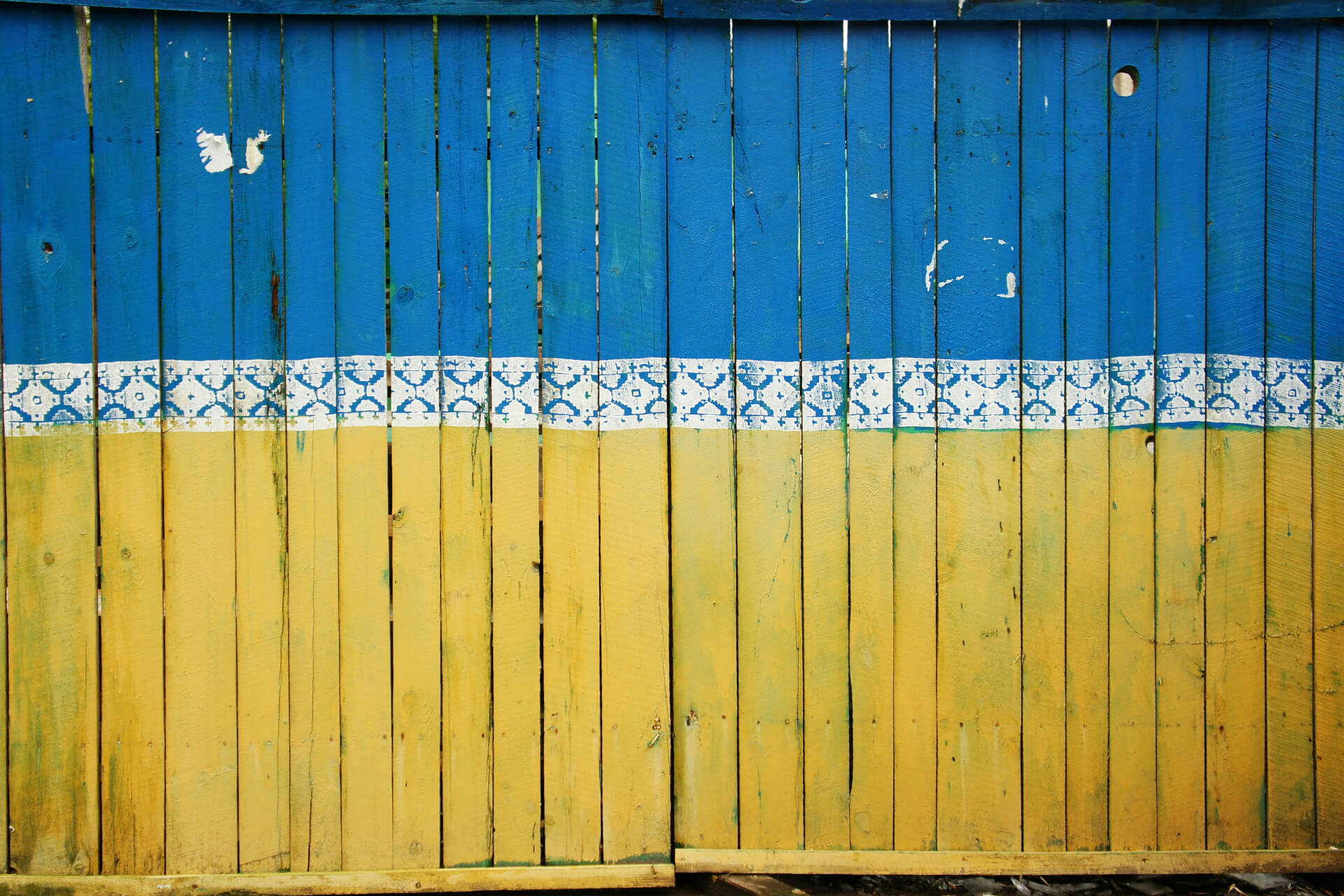
In Vilnius, the Ukrainian flag never seemed to come down.
From the earliest days, Lithuanian citizens gathered in cathedral squares and outside parliament buildings. Candles flickered beneath banners that read: “Your fight is our fight.”
One of the most visible civic movements, Blue/Yellow, mobilized thousands of volunteers to fund protective gear, vehicles, and humanitarian aid. What began years earlier as a modest initiative became a national effort, proof that solidarity could be organized as carefully as any military operation.
Standing with Ukraine is not charity for us. It is solidarity.
The reminder was constant and deliberate. Lithuanians knew their own history of occupation and resistance. In supporting Ukrainians, they were also honoring their past — and safeguarding their future.
We stand because we stand together.
Year Four: The Long Resolve
Four years into the war, the story is no longer only about survival. It is about continuity.
Ukrainian civil society has become a parallel backbone of the nation — documenting losses, planning reconstruction, advocating for justice, caring for veterans, supporting widows and orphans, rebuilding libraries and launching startups even as missiles still fall.
In bombed-out towns, volunteers plant trees. In cities far from the front, hackathons design demining technology. Civic watchdogs track every reconstruction contract, determined that transparency will survive alongside sovereignty.
Lithuanian municipalities twin with Ukrainian towns. Cultural exchanges continue. Aid convoys depart not as breaking news, but as routine commitments. Civil society cannot stop missiles. But it can stop despair from becoming destiny.
In basements in Kyiv, in town halls in Vilnius, in classrooms rebuilt brick by brick, ordinary people keep reminding one another that solidarity is not a slogan.
We stand because we stand together.