© The Garden of Hope Foundation


2026-04-01
Women Defending Gender Rights in Deteriorating Enabling Environments
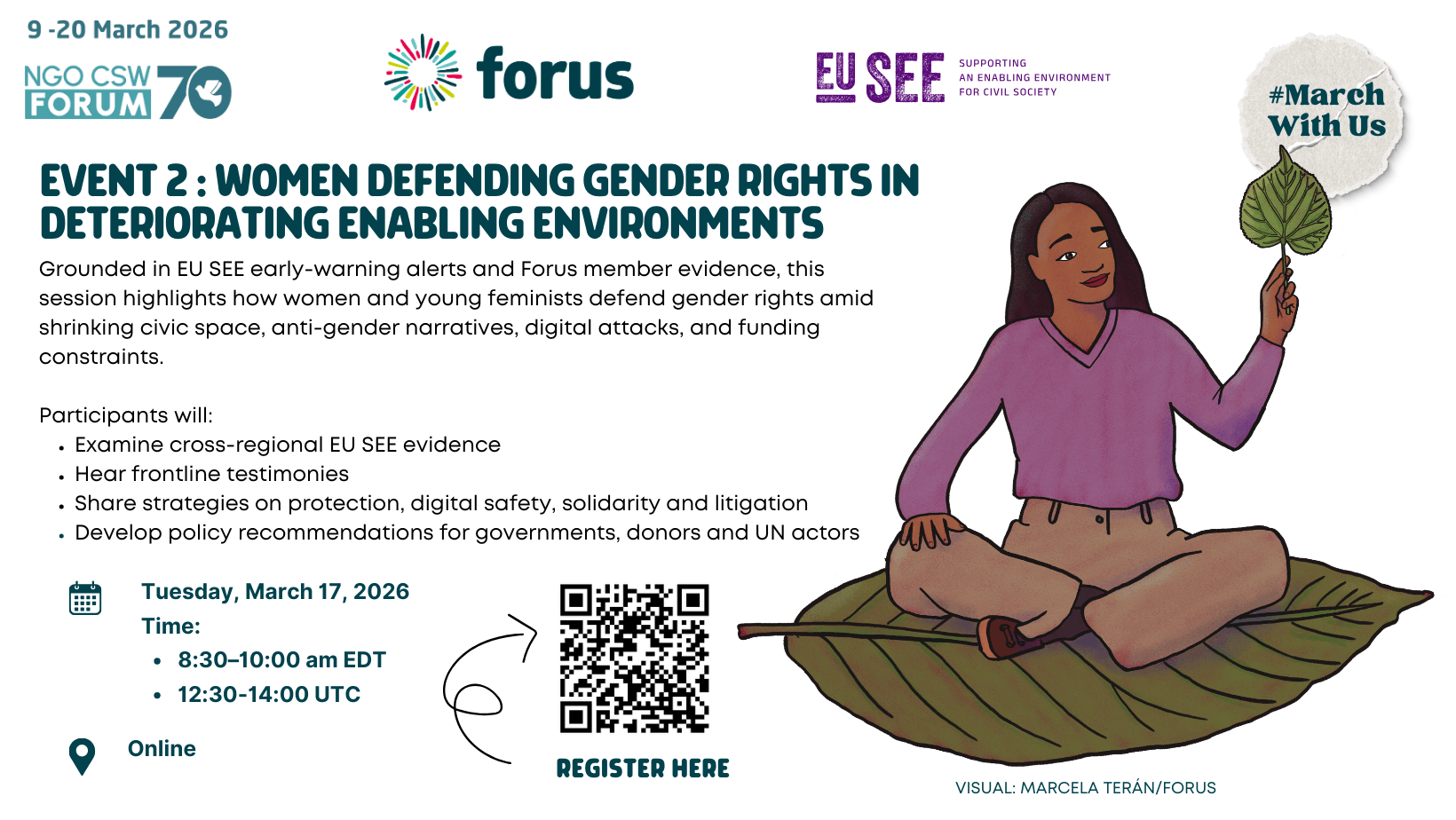
As gender rights come under increasing pressure worldwide, women’s rights defenders and feminist activists are adapting, resisting and building new forms of collective power. At the side event “Women Defending Gender Rights in Deteriorating Enabling Environments,” organized by the European Union System for an Enabling Environment for civil society (EU SEE) Consortium and Forus as part of the March With Us campaign for gender justice, speakers from across regions shared a clear message: the space for gender justice is shrinking—but it is far from silent.
Across contexts, the threats are converging. Restrictive laws, defunding of women’s rights organizations, rising anti-gender narratives and direct intimidation are reshaping the conditions under which activists operate. Women and gender-diverse defenders are disproportionately affected—facing both systemic exclusion and targeted backlash.
Yet the response is equally global. From Argentina to Afghanistan, Somalia to Malaysia, and Colombia, feminist movements are not retreating. They are reorganizing.
A Shrinking Space, Unequal Impact
Presenting findings from EU SEE monitoring, researcher Lena Muhs identified three recurring patterns.
First, direct intimidation and violence against gender activists. “Organizations are attacked either because of their work on gender, or because of who they are,” she explained.
Second, legal regression, including the rollback of protections and the introduction of restrictive laws. In some contexts, institutions dedicated to women’s rights have been dismantled or absorbed into weaker structures.
Third, structural exclusion, with gender perspectives removed from education, policy, and public discourse.
These dynamics reinforce one another. As Lena noted, “We see more self-censorship, more fear to organize.” The enabling environment for civil society is not shrinking equally—it is shrinking faster and harder for women-led and LGBTQIA+ groups.
Funding cuts further intensify this pressure. With governments withdrawing support and international funding declining, many organizations face existential uncertainty.
Argentina: Rapid Policy Rollback
Marita González from CGTRA Argentina described Argentina as a “paradigm shift in reverse.” Since late 2023, the government has dismantled key gender institutions, including the Ministry of Women, Gender and Diversity, and cut funding for sexual education and social programmes.
Legal protections have also come under threat, alongside public narratives framing feminism as a “destructive ideology.”
The result is a dual pressure: institutional rollback combined with political stigmatization. Women’s organizations now operate in an environment where both policy and discourse undermine their legitimacy.
Afghanistan: Naming Gender Apartheid
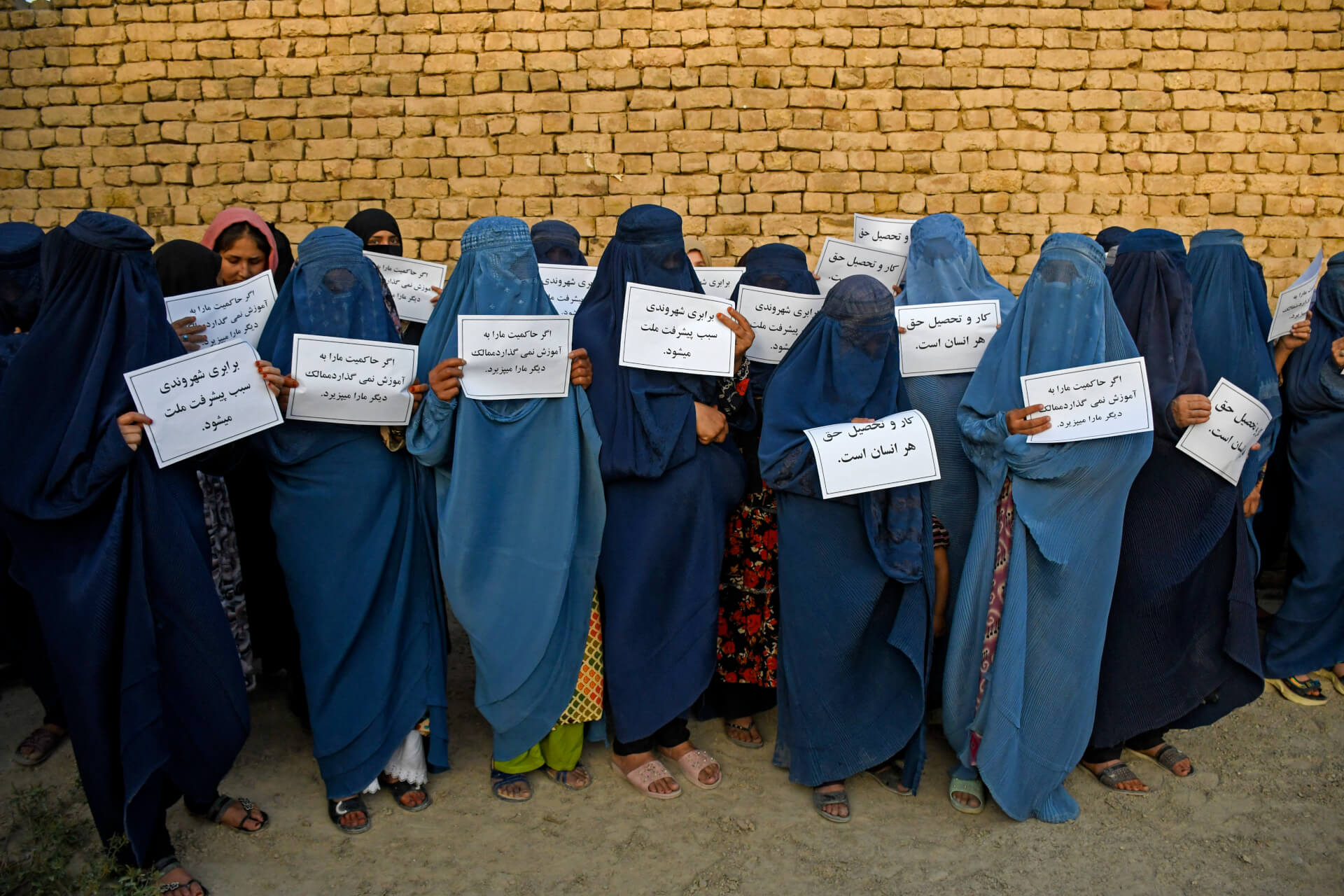
Horia Mosadiq, Human Rights Defender from Afghanistan, delivered one of the most urgent interventions. Since 2021, Taliban rule has systematically erased women from public life: banning education, restricting movement and excluding women from most forms of work.
She described the situation clearly: “This is gender apartheid—systematic discrimination and persecution of women and girls because of our gender.”
Despite this, Afghan women continue to organize—through underground education, advocacy and international legal efforts.
Her call was direct: “Please join us in recognizing and codifying gender apartheid as a crime under international law.”
She also warned that failure to act risks global consequences: “Other groups are watching. This model can spread.”
Somalia: Layered and Invisible Violence
Iman Ahmed Abdikarin highlighted how gender inequality in Somalia is sustained through overlapping pressures: weak legal protections, harmful practices and growing digital harassment.
Gender equality is often framed as a foreign concept, delegitimizing advocacy from the outset. Women activists face both online attacks and community-level pressure discouraging participation.
As one reflection during the session noted, the violence is not only physical: “It is systematic, cultural, digital—and reinforced by laws that fail to protect.”
Malaysia: Winning in Court, Losing in Practice
Jernell Tan Chia Eu shared the case of Sisters in Islam (SIS Forum Malaysia), which won a landmark court ruling invalidating a fatwa labeling the organization “deviant.”
Yet the victory was partial. Authorities forced the group to rebrand and continue to stigmatize its work.
“This is narrative warfare,” Jernell explained.
“The state positions rights-based advocacy as an attack on religion.”
Even after legal success, activists face exclusion, reputational damage and personal risk. The case illustrates a broader trend: legal wins do not automatically expand the enabling environment for civil society.
Colombia: More Participation, More Violence
Marcela Restrepo Hung , Executive president of the Fundación Foro Nacional por Colombia highlighted a troubling paradox: as women’s political participation increases, so does violence against them.
Cases of electoral violence against women have risen sharply in recent years, including threats, smear campaigns and physical attacks.
“As participation increases, violence increases,” she noted.
Women leaders—especially in rural and marginalized communities—face the highest risks. Even progressive political spaces are not immune. Discriminatory narratives persist across the political spectrum.
Strategies of Resistance
Despite these challenges, speakers emphasized that feminist movements are adapting in strategic ways.
1. Building alliances across sectors: Civil society fragmentation weakens collective power. “We tend to work in silos,” Jernell noted. “But threats to civic space affect everyone.”
Cross-sector collaboration—between feminist, human rights, and LGBTQI+ groups—is increasingly essential.
2. Reclaiming political space: Marcela challenged the idea that civil society should remain outside politics. “Politics is where transformation happens,” she said. “We must see it as a natural space, not something to avoid.”
3. Strengthening digital and physical safety: From Somalia to Malaysia, activists are investing in digital security and safer organizing strategies, adapting to both online and offline threats.
4. Using data for advocacy: EU SEE monitoring tools help organizations anticipate risks and strengthen advocacy.
“Reporting allows us to anticipate challenges and protect communities,” Iman explained.
For others, the data provides legitimacy and visibility—helping translate local struggles into global awareness.
The Funding Crisis
Across all interventions, one issue stood out: resources.
Without sustainable funding, feminist movements cannot operate, organize or influence policy. As Marcela put it:
“Without financial sustainability, there is no political sustainability.”
Participants emphasized that funding is not a technical issue—it is a structural one. States must take responsibility for supporting civic participation, rather than relying solely on shrinking international aid.
Solidarity remains essential—but it is no longer enough.
What is needed now is action:
Protect civic space through legal and institutional safeguards
Invest in feminist and youth leadership
Ensure sustainable funding for civil society
Recognize and respond to emerging threats, including digital violence and anti-gender narratives
The experiences shared point to a broader truth: attacks on gender rights are not isolated incidents. They are part of a global pattern—and an early warning sign of democratic decline.
Across regions, feminist activists are not only defending rights—they are sustaining democratic space itself.
They are documenting abuses, organizing communities, challenging narratives, and pushing institutions to respond.
As one speaker reminded the audience, the stakes are clear:
When women are silenced, democracy weakens.
When feminist movements are supported, democracy deepens.
The question is no longer whether women are leading change. They are.
The question is whether institutions will match their courage with protection, resources, and action.
Title
See all