

Mon 9 Nov 2026
Spot it, stop it, tell it: how civil society can respond to misinformation
The Forus Communicators’ Series
Each thematic session of this series will therefore be linked to practical workshops where participants can apply the concepts explored and develop communications products tailored to their own platforms, audiences and objectives.
Misinformation about civil society builds a whole story: that organisations serve foreign interests, divide communities or defend disorder. That was the starting point of the recently organised “Misinformation response Lab”, the latest session of the Forus Communicators’ series that brought together Forus members and partners from across the network.
This very practical session started off with participants naming the harmful narratives they see in their own contexts, who spreads it, what fears it taps into, what evidence contradicts it and who could respond in a credible way. Prebunking – which prepares the audience in advance to recognise manipulation tactics, and debunking – which responds once a misleading narrative has already appeared - were also discussed during this session.
What the evidence shows
Lena Muhs, EU SEE research lead at Forus used data gathered from monitoring by national network members in 82 countries, including over 1000 alerts reported to date to talk about the following:
- Delegitimsation is a pattern: civil society actors are portrayed as foreign-influenced, as troublemakers or as co-opted by the opposition. Marginalised groups and sensitive movements, such as elections, are hit hardest.
- Digital spaces speed it up: in Argentina, the president posted around 1000 times in one weekend attacking journalists. In Paraguay, an investigation found public funds used to hire a company to amplify harmful messages.
- It feeds restrictive policy: In some countries, accusations about foreign funding led to parliamentary inquiries or tighter rules and laws against “false information” risk being turned against civil society itself.
- It becomes a cycle: less funding means less capacity to respond, which makes organisations even more vulnerable.
As Lena put it, the result is a vicious cycle: "You have less funding because access to funding was restricted using misinformation against civil society, and then with that less funding also means you have less capacity to respond to these kinds of misinformation."
Strategies documented by EU SEE members go beyond communications: investigative journalism and prosecution (Paraguay), reporting to UN special rapporteurs (Bolivia), civic education, digital literacy and spotting trends early in countries where they are just emerging.
Lessons from the Forus Journalism Programme
Two fellows from the Forus Journalism Programme brought in experience from their own national and regional contexts.
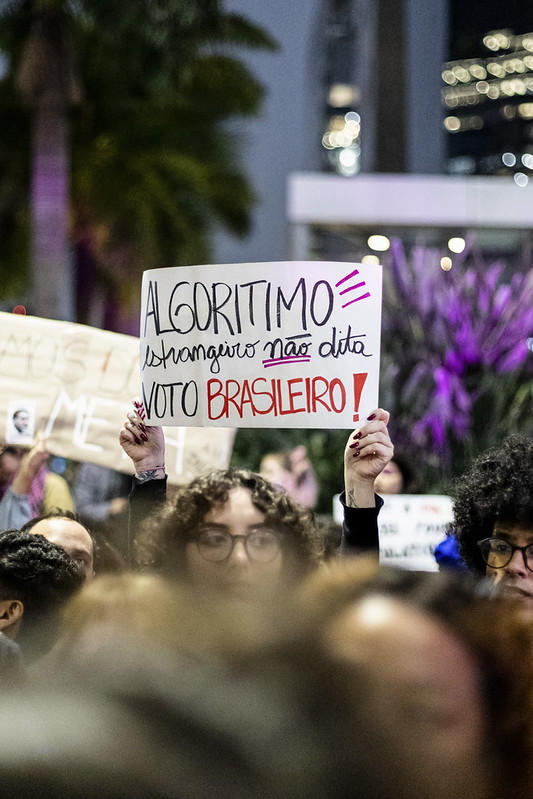
Natali Carvalho, presented her work on digital political violence against women in Brazil during the recent elections. She argued for stronger platform regulation and for technology developed with and by communities. She opened with two figures. 81% of the cases of political violence recorded online in the first round of the 2026 elections had women as victims. And 8.8 million Brazilian women reported experiencing digital violence in the 12 months before a 2025 survey.
Her central point was that the problem is not only false content: “It is the system that distributes it.”
She identified four features of that system:
- Amplification: engagement logic can boost harmful content and attacks.
- Opacity: platforms offer little transparency or access to their criteria.
- Automation: AI can facilitate attacks and reproduce bias, including in moderation.
- Silencing: coordinated attacks and unequal moderation can push voices out.
She cited researcher Helena Martins of the Federal University of Ceará, who argues that what users face today is “a private censorship, not discussed, imposed through terms of use that you don’t even have the choice to accept or not”. Ana Bárbara Gomes of the Institute for Research on Internet and Society (IRIS) added that regulation alone will not correct historical inequalities, so the fight has to continue on several fronts, including content moderation rules and platforms’ responsibility on hate speech.
Beyond denouncing the problem, Natali showed Brazilian initiatives that build alternatives:
- QuitérIA (Instituto AzMina) uses AI to support legislative monitoring from a feminist perspective.
- Sentinela (VoteLGBT) uses technology to identify and document attacks on LGBTQIA+ people.
- Plantão Colmeia offers support and guidance to people affected by digital political violence.
- Olabi invests in training, media education and the inclusion of Black women in technology.
Her conclusion: the response to disinformation cannot stop at correcting content. “We need to contest who controls the technology, what interests it serves and what futures it makes possible.”
Nfor Hanson presented three cases from West Africa and presented three case studies from his fellowship reporting, which he framed as four steps any organisation can reuse:
- Spot it: Paradigm Initiative in Nigeria found that digital threats harm civic participation through misinformation and manipulation. It built a digital literacy project, later expanded through Ripoti (digital rights reporting) and Ayeta (a digital security toolkit). The lesson: equip people to question sources and verify information before sharing, because passing on fake information can cost an organisation dearly.
- Stop it: The Nigerian Network of NGOs . During the EndSARS protests, website attacks and hijacked social media accounts weakened the network’s communication and trust. It organised capacity-building meetings, reported the attacks and escalated them to platforms and authorities. The lesson: secure your communication channels with robust passwords and systems and authenticate information to maintain public trust.
- Tell it: Evidence-based storytelling that documents what happened and explains it clearly. “It’s not only about journalists,” he said. “CSOs and NGOs can do this.”
- Refame it: Togo and Senegal. Drawing on his article “The Collective Shield”, he described how FONGTO organised capacity-building workshops in Togo when street protests were banned, and how CONGAD joined the “Aar Sunu Election” campaign in Senegal. WACSI helped document violations in Togo and amplify concerns through regional and international mechanisms. The lesson: global solidarity should be framed around “shared responsibility, mutual learning and cooperation, rather than a one-way relationship between donors and beneficiaries”.
"Countering misinformation is not only about correcting false claims, it is also about building trust, explaining evidence clearly, and creating narratives that encourage understanding rather than division." It is, he added, "not just going online to say, this is false, disregard it."
Putting it to the test
Participants then worked through two scenarios based on real experiences affecting civil society: a platform accused of serving foreign donors after speaking up on an enabling environment issue and an organisation whose statement on Police intervention is quoted out of context. The question for each: what message, action or decision would your organisation take and do you need to respond publicly at all?
The discussion showed how current the challenge is. A participant from TANGO, the national umbrella organisation in The Gambia and Forus member, described doing constant fact-checking during an ongoing electoral cycle.
Forus will keep building spaces where communicators can exchange what works, with the member-to-member system and the Communicators’ Series as the main routes. If your organisation is facing a narrative like those discussed, share it with the network so others can learn from your experience.
Resources
- Presentations from all speakers including a selection of resources in English, French, Spanish and Portuguese
- IPPF "Facing the Fire" toolkit on preparing for anti-rights narratives